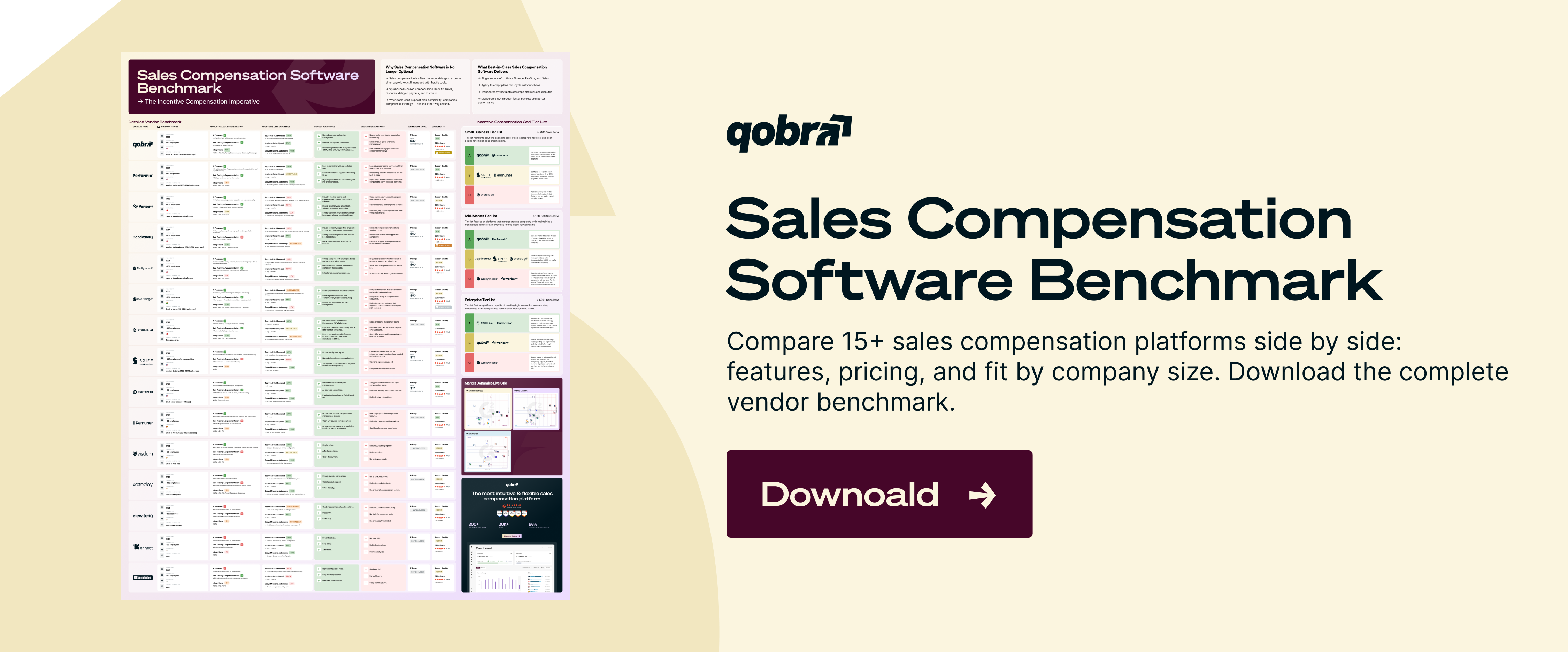
Sales Compensation Software Benchmark | Compare 15+ Platforms (Features, Pricing, User Reviews, etc.)
Download
- Salesforce is covered natively by all eight platforms; HubSpot by six, since Xactly does not list it and Spiff routes non-Salesforce sources through the Workato iPaaS.
- US payroll is the weak spot: only QuotaPath (Rippling) lists a native payout push to a payroll system; most vendors sync HRIS data in and hand payroll a file out.
- CaptivateIQ, Everstage and Performio publish the widest integration lists, including ADP Workforce Now, Workday, NetSuite and QuickBooks Online.
- Xactly and Varicent are built around a connector and SQL/ETL layer rather than a long list of named apps, which fits enterprise data teams and adds implementation work for mid-market ones.
- Qobra connects natively to Salesforce, HubSpot, Microsoft Dynamics, Snowflake, BigQuery, Workday and SFTP/CSV; its US payroll and ERP connections are marked to validate in this draft.
Why integration depth decides whether commission automation works
Integration depth matters because a commission plan is only as accurate as the data that reaches it, and how fast that data arrives. A rep who sees a closed-won deal in Salesforce on Tuesday and no commission until next month does not trust the number, and a comp admin who re-keys 400 deals will make errors. In the US, where biweekly pay is the most common frequency according to the Bureau of Labor Statistics, a slow pipeline means missing a payroll cut-off every two weeks.
Not every "integration" logo means the same thing. We sort them into three levels, and the matrix below uses the same vocabulary.
- Native sync. The commission vendor builds and maintains the connector. You authenticate, choose objects and fields, set a schedule, and the data lands as tables the plan engine can read.
- Connector. A generic bridge: a database or ODBC/JDBC connection, a REST or webhook endpoint, or an iPaaS such as Workato. Flexible, but someone on your side (or a partner) designs and maintains the recipe.
- Via export or file. You export a CSV from the source system and upload it, or drop it on SFTP on a schedule. Auditable, but every run depends on a person or a script.
A fourth state, Not listed, means the vendor's public integrations page did not name the system when we checked. Ask for a live demo of it before you sign.
The integration matrix: 8 commission platforms across 12 US systems
Rows are commission platforms, columns are the systems a US mid-market revenue team typically runs. "Native" means the vendor lists a maintained connector for that system on its own site.
Two patterns stand out. CRM coverage is a solved problem: the differences are in sync frequency and write-back. US payroll is where lists get short: most vendors treat ADP and Workday as sources of employee data, while the payout leaves as a file. Only QuotaPath describes pushing commissions into a payroll system (Rippling).
CRM integrations: what syncs from Salesforce, HubSpot and Dynamics, and how often
All eight platforms read Salesforce and most read HubSpot and Dynamics natively, so the real questions are which objects sync, how often, and whether earnings flow back into the CRM. For a 50-rep US team, a daily sync is enough for month-end; a rep dashboard that lags the pipeline by a day will drive questions to your comp admin.
Salesforce commission tracking: objects, frequency, write-back
Salesforce commission tracking works best when the tool reads Opportunity, Opportunity Product, Account and User, plus custom objects such as Order or Invoice, on a schedule you control. Spiff, now part of Salesforce, is the most tightly coupled: it runs on the Salesforce platform, so opportunity data is available without a separate sync job. CaptivateIQ, Everstage, Performio, Varicent and Qobra maintain their own Salesforce connectors with object and field selection. QuotaPath imports "any Salesforce object" and ships an AppExchange app that shows earnings inside Salesforce. Xactly reaches Salesforce through Xactly Connect, its SQL-based integration layer.
Write-back is where platforms split: showing expected commission on the opportunity record requires the vendor to push a field back into Salesforce, so ask to see it live. For a deeper walkthrough, see our guide to sales commissions and Salesforce integration and our comparison of the best sales commission software for Salesforce users.
HubSpot: the default CRM outside the Salesforce ecosystem
For HubSpot teams, the strongest options are vendors with a native HubSpot connector: QuotaPath (which also ships a HubSpot app), CaptivateIQ, Everstage, Performio, Varicent and Qobra. Spiff does not name HubSpot on a public page; its help documentation routes non-Salesforce sources through Workato. Xactly does not list HubSpot. Deals, line items, companies and owners are the usual objects; if you need custom objects, confirm the connector reads them. Our article on the HubSpot API for sales teams explains the field-level details.
Microsoft Dynamics 365
Dynamics 365 Sales is listed natively by CaptivateIQ, Everstage, Performio, Varicent and Qobra; QuotaPath and Xactly do not list it, and Spiff would rely on Workato. Dynamics customers often pay on orders and invoices, so check that the connector reads those objects, not only Opportunities.
Payroll and HRIS integrations: ADP, Workday, Rippling, Gusto, Paylocity
Most commission platforms integrate with US payroll in one direction: they pull employee, hire date, manager and termination data from the HRIS, then produce a payout file for payroll to import. An API push of approved payouts into payroll is rare; only QuotaPath describes it, for Rippling.
Payout file versus API
A payout file is a CSV formatted to the payroll system's import template: employee ID, earnings code, amount, pay date. It works with ADP Workforce Now, Paylocity, Paycom and Gusto without a connector, and it gives finance a document to approve before money moves. The cost is a manual step every cycle and a stale file if adjustments land after export.
An API push removes that step, but it must respect the provider's earnings codes and cut-offs and sit behind an approval workflow. Ask who can trigger the push, whether re-running it can double-pay, and how a reversal is handled.
US pay cycles change the requirement
Semi-monthly (24 pay dates) and biweekly (26 pay dates) cycles are both common in US sales organizations, and many companies pay commissions monthly or quarterly after the close. Whatever the cadence, the tool needs a locked statement period, a payroll cut-off calendar and a rule for late adjustments (next cycle, with an audit entry). Commissions are supplemental wages for federal withholding purposes, so the payout file should carry the right earnings code; the IRS explains the flat-rate method in Publication 15. For the full workflow from statement to pay run, read our guide to sales compensation and payroll software for SaaS companies.
Vendor by vendor
- Workday: native for CaptivateIQ, Everstage, Performio, Varicent and Qobra; Spiff announced a Workday integration in its April 2022 release; QuotaPath and Xactly do not list it publicly.
- ADP Workforce Now: native for Qobra, CaptivateIQ, Everstage, and Performio. Not listed by QuotaPath, Xactly or Varicent.
- Rippling: native only for QuotaPath, which also pushes payouts. Everyone else: not listed.
- Gusto: native for Everstage only.
- Paylocity: not listed by any vendor in this comparison; plan on a payout file.
ERP and accounting integrations: NetSuite, QuickBooks, accruals and ASC 606
ERP integrations do two jobs CRM data cannot: paying on invoice or cash collected, and booking commission expense correctly. NetSuite is listed natively by CaptivateIQ, Everstage, QuotaPath, Performio and Xactly, and Spiff holds "Built for NetSuite" status. QuickBooks Online is listed natively by CaptivateIQ, Everstage, QuotaPath and Performio. Varicent lists neither; Qobra's cells are placeholders in this draft.
On the accounting side, ASC 606 and ASC 340-40 require companies to capitalize incremental costs of obtaining a contract, which includes most sales commissions, and amortize them over the expected customer life. The commission platform should export, per statement period, approved payouts by rep and by deal with the contract identifier, so accountants can build the capitalization and amortization entries. A monthly accrual export (earned but unpaid) is the second must-have; few vendors post journal entries themselves. If your finance team runs QuickBooks, our guide to commission tracking with QuickBooks covers the reconciliation steps. For the controls side, see our article on commission software audit trails for SOX and ASC 606.
Data warehouses and custom sources: Snowflake, BigQuery, SFTP
A data warehouse connection is the most flexible integration, because your data team shapes the input once and reuses it for every plan. Snowflake is listed natively by every vendor here except QuotaPath; BigQuery is listed by CaptivateIQ, Everstage, Performio and Qobra, but not by Xactly, Varicent or QuotaPath. Qobra also lists PostgreSQL, Microsoft SQL Server and Redshift.
Warehouse-first setups suit usage-based or multi-product commissions where the "deal" is a calculated table, not a CRM record. The trade-off is ownership: when the plan pays wrong, the fix may sit in a dbt model rather than in the commission tool.
SFTP remains the universal fallback. A scheduled, encrypted drop of a well-defined file is auditable and rarely breaks. CaptivateIQ, Everstage, Performio, Varicent and Qobra list SFTP; QuotaPath and Xactly rely on API and connector routes instead. For custom sources, CaptivateIQ, QuotaPath, Performio and Varicent publish an open or REST API, Spiff exposes a REST Import API and webhooks, and Xactly offers ODBC/JDBC drivers and ETL through Connect.
How Qobra connects a typical US mid-market stack
Qobra, headquartered in New York and Paris, connects a 50-to-500-rep US team through a native CRM sync, an HRIS sync and a payroll export, with $1B+ in commissions managed across 300+ companies. The typical configuration is Salesforce or HubSpot as the deal source, Workday, BambooHR or HiBob for people data, and a payout file for the payroll provider.
CRM in. Qobra's Salesforce, HubSpot, Microsoft Dynamics, Zoho, Pipedrive and Odoo connectors pull the objects your plan needs on a schedule. Reps see attainment and earnings update as deals move; managers see team totals without asking finance.
People data in. The Workday, BambooHR and HiBob connectors bring hire dates, roles, managers and terminations, so plan assignments and proration follow the HRIS. The HiBob integration uses OAuth and is listed on the HiBob marketplace.
Payouts out. Approved statements export to a payout file per pay period, with the audit log recording who changed what and when. Qobra's US payroll and ERP connectors.
Anything else. Snowflake, BigQuery, PostgreSQL, Microsoft SQL Server, Redshift and SFTP/CSV cover billing, usage and legacy sources.
The full list of connectors is on our integrations page, and our guide to commission reporting and analytics software shows what you can build once the data is in one place.
What integration depth costs
Integration tiers are where pricing differences hide. QuotaPath publishes its prices: Growth at $35 per user per month plus a $525 monthly platform fee, and Premium at $50 per user per month plus $800 per month, both billed annually; Rippling payout sync and NetSuite are Premium-only (vendor website, Sept 2026). Qobra, CaptivateIQ, Everstage, Spiff, Xactly, Performio and Varicent are quote-based; enterprise connectors or warehouse access may be add-ons. When comparing quotes, ask which connectors your tier includes and what a payroll push costs.
FAQ: commission software integrations
Compare the integration depth of various commission platforms for syncing complex sales data
CaptivateIQ, Everstage, Performio and Qobra list native connectors across CRM, HRIS, ERP and data warehouses, which covers complex sales data (multi-object, invoice-based, usage-based) without custom code. Xactly and Varicent offer SQL and ETL layers that handle any structure but need a data owner. Spiff is deepest on Salesforce and relies on Workato elsewhere. QuotaPath covers HubSpot, Salesforce, QuickBooks and NetSuite but not warehouses.
Which platforms link sales records to payroll for automatic payouts?
On public pages, QuotaPath is the only platform in this comparison that describes sending approved commissions directly into a payroll system (Rippling, Premium tier). CaptivateIQ, Everstage and Performio sync ADP Workforce Now and Workday data in, and payouts typically leave as a formatted payroll file. Qobra syncs Workday, BambooHR and HiBob and exports payout files.
Find me a commission platform that integrates seamlessly with major CRM systems
Salesforce, HubSpot and Microsoft Dynamics are all natively supported by CaptivateIQ, Everstage, Performio, Varicent and Qobra. QuotaPath covers Salesforce and HubSpot with marketplace apps. Spiff is native on Salesforce only. Xactly connects to Salesforce through Xactly Connect. Beyond the logo, verify scheduled sync frequency, custom object support and whether earnings can be written back to the CRM record.
Which software integrates with my CRM to calculate commissions for a team of 50 in the US?
For a 50-rep US team, look for a native connector to your CRM, a native HRIS sync for hire and termination dates, a payout file matched to your payroll provider's template, and a rep-facing dashboard. Qobra, CaptivateIQ, Everstage, Performio and QuotaPath fit that profile on Salesforce or HubSpot; Qobra and QuotaPath also offer a no-code plan builder for teams without a comp analyst.
Which commission software works best outside the Salesforce ecosystem?
For HubSpot, Dynamics, Zoho or Pipedrive shops, the best fit is a vendor with native connectors for those CRMs and no dependency on the Salesforce platform. Qobra lists HubSpot, Dynamics, Zoho, Pipedrive and Odoo natively; CaptivateIQ, Everstage and Performio list HubSpot and Dynamics; QuotaPath ships a HubSpot app. Spiff, which runs on Salesforce, is the least natural choice outside that ecosystem.
List tools that offer secure API connections between sales management and payroll software
Vendors publishing an API include Qobra (open API), CaptivateIQ (open API), QuotaPath (open API), Performio (REST API), Varicent (REST API), Xactly (REST API plus ODBC/JDBC) and Spiff (REST Import API and webhooks). QuotaPath is the one that documents a direct payroll push (Rippling). For the others, the secure route to payroll is a scheduled SFTP payout file with approval gating and an audit log.