Webinar: The Biggest Release Sales Comp Has Ever Seen. Come See For Yourself (Wednesday, October 7)
Register
- Automate and centralize commissions: a dedicated platform ingests CRM/ERP data, performs real-time calculations, and single-sources payouts to eliminate spreadsheet error and manual reconciliation.
- Prioritize core features: a no-code rule engine, real-time dashboards for reps and managers, native integrations, audit trails, dispute workflows, and advanced reporting/forecasting.
- Expect measurable ROI: large time savings for Finance/RevOps (days per month), up to ~90% fewer payout errors, higher quota attainment among reps, and clearer cost-to-revenue visibility.
- Choose based on scale and TCO: map current and future plan complexity, evaluate ease of admin and rep adoption, verify pre-built integrations, and factor implementation, support, and consulting costs.
- Implementation best practices: clean and validate CRM data first, pilot core plans, run end-to-end tests including payroll exports, require demos and an ROI/business-case, and confirm support/SLAs before signing.
Are your sales and finance teams still drowning in spreadsheets to calculate commissions? While familiar, tools like Excel and Google Sheets often become a source of frustration, quietly draining time, trust, and revenue. Studies show that a majority of employees—up to 68%—are dissatisfied with manual commission management. The reasons are clear: spreadsheets are prone to errors (31%), unnecessarily complex (28.8%), and lack transparency (24%), leaving sales reps confused and finance teams overwhelmed.
Objections like “Why pay for software when we already use Excel?” ignore the high hidden costs. These include countless hours spent reconciling data, disputes over inaccurate payouts, and a demotivated sales team unable to track their earnings in real time. But what if your commission process could be transformed from an operational headache into a strategic growth lever?
Modern sales commission software automates calculations, guarantees accuracy, and gives your entire organization real-time visibility into performance and earnings. It turns compensation into a powerful, predictable driver of business growth. In this guide, we'll explore how these platforms work, the key features to look for, and how to select the right solution to eliminate spreadsheet chaos and align your sales incentives with your company's strategic goals.
Why Move Beyond Spreadsheets? The Tangible ROI of Commission Software
The shift away from manual commission management is not just a trend; it's a strategic business decision. High-performing revenue teams understand that how you manage commissions directly impacts profitability, employee retention, and overall company performance. The right platform delivers measurable returns across the entire organization, from sales and finance to operations and HR.
Save Time and Eliminate Manual Work
The most immediate benefit of a dedicated commission tool is the massive reduction in manual effort. By automating data ingestion from your CRM, ERP, and other systems, the software eliminates the need for manual data entry and validation. Calculations are performed automatically, and payroll exports are generated with a few clicks.
For Finance and RevOps teams, this translates to saving days of work every single month. Instead of spending time validating complex spreadsheets and chasing down data, they can focus on strategic analysis and optimizing compensation plans to drive better results. This is a crucial step in building a more efficient sales commission process.
Increase Transparency and Trust
Trust is the foundation of a motivated sales team. When commissions are calculated in a "black box," reps often feel suspicious and disengaged. Automated software provides a single source of truth, with reliable formulas and real-time visibility that build confidence. Research indicates that 84.2% of employees who are satisfied with their commission plans use dedicated software, while nearly half of spreadsheet users report dissatisfaction.
By giving every stakeholder—from reps and managers to finance leaders—access to the same accurate, up-to-date information, you eliminate disputes and foster a culture of transparency. This alignment is one of the key benefits of a reliable commission tool.
Boost Sales Performance and Motivation
When sales reps can see their potential earnings update in real-time after closing a deal, it creates a powerful motivational feedback loop. Real-time progress tracking keeps them engaged, goal-oriented, and focused on the activities that generate the most revenue.
The data speaks for itself: 61.9% of sales reps using commission software exceeded their targets, compared to only 30.1% of those using spreadsheets. This direct link between daily activities and financial reward turns your compensation plan into a dynamic performance management tool.
Reduce Costly Errors
Manual calculations are a breeding ground for human error. A misplaced decimal point or an incorrect formula can lead to significant overpayments that hurt your margins or underpayments that destroy morale. Automation prevents these costly miscalculations, reducing payout errors by up to 90%. This not only protects the company's bottom line but also eliminates the painful and time-consuming process of resolving payout disputes.
Align Compensation with Business Strategy
A robust commission platform is more than just a calculator; it's an analytical powerhouse. It allows leaders to track performance trends, identify top reps, model the financial impact of plan changes, and design scalable incentive structures that are perfectly aligned with revenue goals. Whether you want to push a new product, enter a new market, or improve margins, the software gives you the flexibility to adapt your sales commission plans quickly and effectively.
Core Features of a Modern Sales Commission Platform
When evaluating different solutions, it’s essential to look beyond the basic promise of automation. The best platforms offer a comprehensive suite of features designed for flexibility, transparency, and scalability. Here are the core capabilities to look for.
Flexible, No-Code Plan Builder
Your commission plans will inevitably evolve as your business grows. You need a system that can adapt without requiring expensive developers or external consultants.
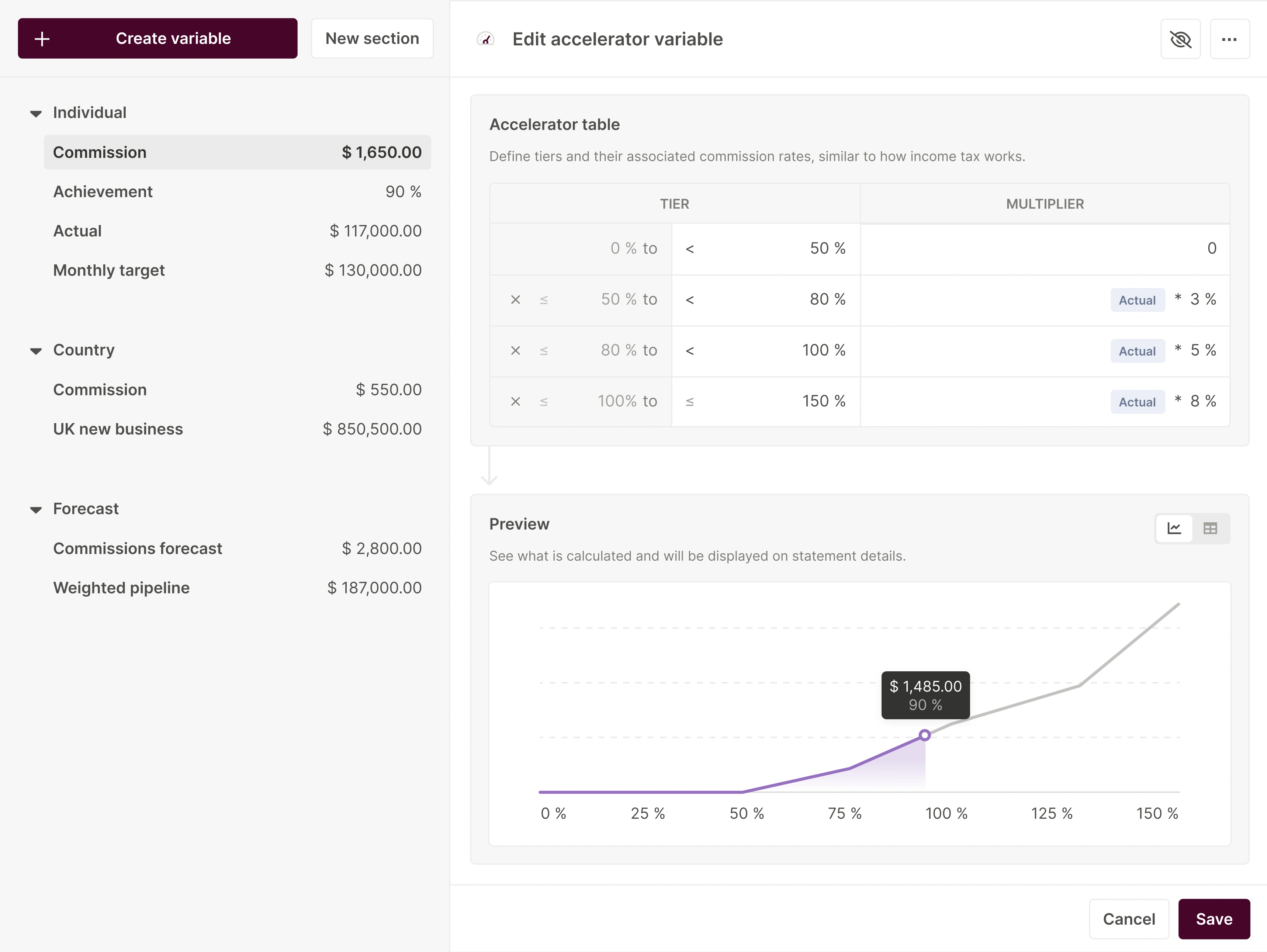
A modern platform should feature an intuitive, no-code calculation engine. This empowers your Sales Ops, Finance, or HR teams to build and modify any commission plan with ease, much like using a spreadsheet but with the power and reliability of an enterprise-grade system. Look for the ability to handle:
- Complex Rules: Tiered rates, accelerators, bonuses, SPIFFs, and clawbacks.
- Team-Based Structures: Overrides for managers, splits, and team-based incentives.
- Custom Logic: Formulas based on any metric, from revenue and profit margin to product-specific quotas.
Platforms like Qobra are built around a powerful no-code editor, allowing administrators to configure and deploy plans in minutes, not months.
Real-Time Calculations and Dashboards
The days of waiting until the end of the month or quarter to see commission statements are over. A key feature is the ability to perform calculations in real time, with data flowing seamlessly from your CRM. This powers individual dashboards for sales reps, giving them an up-to-the-minute view of their performance, current earnings, and potential future payouts. For managers and finance, aggregated dashboards provide a clear overview of team performance and total commission costs, enabling better forecasting and budget management. This real-time visibility into commissions is a game-changer for motivation.
Seamless Data Integration
Your commission software should act as a central hub, not another data silo. It needs to connect natively with the critical systems where your business data lives. A single source of truth is essential for accuracy and efficiency. Key integrations include:
| Integration Type | Examples | Purpose |
|---|---|---|
| CRM | Salesforce, HubSpot | To pull deal, account, and rep data. |
| ERP / Finance | NetSuite, Sage, QuickBooks | To reconcile with billing and accounting records. |
| Data Warehouse | Snowflake, BigQuery, PostgreSQL | To incorporate custom business logic or datasets. |
| HRIS | Workday, Personio | To manage employee data, roles, and targets. |
| Communication | Slack, Microsoft Teams | To send real-time notifications on closed deals and payouts. |
Robust, native integrations ensure that your data is always clean, current, and synchronized across your entire tech stack.
Note: Data Quality is Key
Remember that any commission software is only as good as the data it receives. Before implementation, ensure your CRM data is clean and well-structured. A successful rollout depends on accurate deal ownership, correct amounts, and consistent status tracking. The software doesn't clean your data; it processes it.
Dispute Management and Audit Trails
Even with automation, questions and disputes can arise. A best-in-class platform includes a built-in workflow for managing disputes. Reps can flag a specific deal or calculation directly within the tool, triggering a notification to their manager or the commission administrator. The entire conversation is tracked in one place, creating a clear and auditable record of the resolution. This audit trail is also critical for compliance, providing complete traceability from the initial data point to the final payout.
Advanced Reporting and Analytics
To make your commission plan a strategic asset, you need access to actionable insights. Your software should provide advanced reporting capabilities that go beyond simple payout summaries. Look for the ability to:
- Track performance against quota for individuals and teams.
- Analyze commission costs as a percentage of revenue.
- Forecast future payouts based on the sales pipeline.
- Identify top performers and analyze what drives their success.
- Model the impact of potential changes to your compensation plan before you roll them out.
How to Choose the Right Sales Commission Software
With a growing market of vendors, selecting the right platform can seem daunting. The best choice depends on your company's size, the complexity of your commission plans, and your long-term growth strategy. Here are key criteria to guide your decision.
Assess Your Current Complexity and Future Needs
Start by mapping out your current commission structures. Are they simple percentage-based plans, or do they involve multiple tiers, overrides, and bonuses? Consider not just what you need today, but where your company will be in two to three years. A solution that works for a 20-person sales team might not scale to support a 200-person global force. Look for a platform that can handle your future complexity without requiring a complete overhaul. This is where a comprehensive guide to sales commissions can help you think through your requirements.
Prioritize Ease of Use and Adoption
A powerful platform is worthless if your teams don't use it. The user experience for both administrators and sales reps is paramount. For admins, the plan builder should be intuitive and flexible. For reps, the dashboard should be clean, easy to understand, and accessible. High user adoption is often driven by simplicity and a design that feels familiar yet powerful. The goal is to find a tool that combines the usability of a spreadsheet with the speed and reliability of automation.
Evaluate Integration Capabilities
Revisit the importance of your tech stack. Create a checklist of your essential systems (CRM, ERP, HRIS) and verify that the vendor offers robust, pre-built integrations for them. Avoid solutions that rely heavily on custom API work, as this can add high cost, complexity, and maintenance overhead to the project. The ideal software should plug into your existing ecosystem seamlessly.
Warning: Beware of Hidden Costs
When evaluating pricing, look beyond the per-user subscription fee. Ask about implementation costs, fees for premium support, and charges for building or modifying commission plans. Some legacy providers rely on a professional services model, meaning every change costs you money. A modern, no-code platform like Qobra puts you in control, eliminating dependence on costly external consultants.
Consider the Total Cost of Ownership (TCO)
The TCO includes more than just the license fee. Factor in:
- Implementation Time: How quickly can you get up and running? Modern platforms can be launched in weeks, not months.
- Internal Resources: How much time will your ops and finance teams need to dedicate to managing the system?
- Consulting Fees: Does the vendor require you to pay for professional services to make plan changes?
- Training and Support: Is onboarding included, and is customer support responsive and helpful?
A platform with a higher initial price but a lower TCO is often the better long-term investment.
The Final Step: Moving from Chaos to Clarity
Adopting a dedicated sales commission software is a transformative step. It moves your organization from a reactive, error-prone process to a proactive, strategic approach to sales compensation. By automating the administrative burden, you free up your teams to focus on what they do best: analyzing performance, refining strategy, and closing deals.
The result is a more motivated, trusting, and high-performing sales organization. Reps are empowered with real-time visibility into their earnings, managers have the data they need to coach effectively, and leadership can confidently align sales incentives with overarching business objectives.
Frequently Asked Questions
What is sales commission software?
Sales commission software is a specialized platform designed to automate the entire process of managing variable compensation for sales teams. It handles everything from importing sales data and calculating complex commission rules to providing real-time dashboards for reps and generating accurate reports for finance and payroll. It replaces manual, error-prone spreadsheets with a reliable, transparent, and scalable system.
How does commission software work?
The software works by connecting directly to your data sources, most commonly your CRM (like Salesforce or HubSpot). It automatically ingests relevant data (e.g., closed deals, revenue, contract value) in real-time. An administrator uses a rule engine—ideally a no-code one—to build the logic of your commission plan. The platform then applies these rules to the incoming data to calculate commissions instantly, displaying the results on personalized dashboards.
How long does it take to implement?
Implementation time varies depending on the complexity of your plans and the quality of your source data. However, modern, user-friendly platforms have significantly reduced this timeline. While legacy systems could take six months or more, many companies can now go live with a new commission system in just a few weeks to three months.
Can commission software handle complex, multi-tiered plans?
Absolutely. This is one of their primary strengths. A robust commission platform is designed to handle virtually any level of complexity, including multi-tiered commission rates, accelerators based on quota attainment, manager overrides, team-based splits, and special incentives like SPIFFs or bonuses for specific products. The flexibility of the rule engine is a key factor to evaluate when choosing your commission software.