Webinar (Wednesday, October 21) — Aligning HR, Finance, and Sales: Mastering Sales Comp Without Breaking Your Plan
Register
- Variable compensation ties pay to performance (Base + Variable = OTE) and should directly support the company's top strategic objectives; set the role-specific pay mix accordingly.
- Core components include commissions (flat, tiered, accelerators), bonuses (project, sign‑on, referral, retention), profit‑sharing, long‑term incentives (stock options, RSUs) and short‑term SPIFs.
- Design with a 5‑step approach: align to strategy; pick clear, controllable KPIs; define pay mix, formulas, tiers/accelerators and payout cadence; keep the plan simple and transparent; document and obtain formal acknowledgement.
- Implement via cross‑functional governance (Finance, HR, Sales), a structured communication rollout, and incentive management technology that automates calculations and gives reps real‑time visibility.
- Continuously monitor and review (annual or quarterly), measure ROI, guard against gaming/unhealthy competition and perceived unfairness, and ensure legal/compliance safeguards (e.g., clawbacks, contract terms).
How do you transform your company's strategic goals into tangible actions that motivate every employee? While a competitive fixed salary is essential for attracting talent, it's the variable component of compensation that truly drives exceptional performance and aligns individual efforts with collective success. A well-structured variable compensation plan is more than just a way to pay commissions; it's a powerful tool to shape behavior, reward excellence, and build a high-performance culture.
At its core, compensation is divided into two main categories. Fixed compensation includes the stable, predictable elements like base salary and benefits, providing employees with financial security. Variable compensation, on the other hand, is the portion of pay that fluctuates based on the achievement of specific, predetermined goals. This performance-based pay can be tied to individual, team, or company-wide results, making it a dynamic lever for growth. Finding the right balance between these key components of total compensation is critical to motivating, engaging, and retaining your most valuable employees.
What is a Variable Compensation Plan?
A variable compensation plan is a formal framework that defines how employees earn additional income beyond their fixed salary based on their performance. It’s designed to incentivize specific behaviors and outcomes that are critical to the company's success, whether that's closing more deals, improving customer satisfaction, or hitting company-wide profitability targets. Unlike fixed pay, which is guaranteed, variable pay is earned and flexes with results, directly linking reward to contribution.
For most sales and revenue-generating roles, this structure is captured by the concept of On-Target Earnings (OTE).
On-Target Earnings (OTE): OTE represents the total potential annual compensation an employee can earn if they meet 100% of their assigned performance targets. It is composed of two parts: the fixed base salary and the variable, performance-based pay.
Base Salary + Variable Pay (at 100% target achievement) = OTE
The ratio between base and variable pay, known as the "pay mix," varies depending on the role's influence on revenue. For example, an Account Executive might have a 50/50 pay mix ($70k base + $70k variable for an OTE of $140k), while a Customer Success Manager might have an 80/20 mix, reflecting a greater emphasis on long-term relationship building over immediate sales.
The Core Components of Variable Compensation
A robust plan often uses a combination of different incentive types to address various business needs and roles. Choosing the right components is key to designing a well-designed incentive plan. Here are the most common forms of variable pay:
Commissions
Commissions are the most direct form of performance pay, typically used for sales roles. They are payments directly proportional to the revenue an employee generates. Commission structures can be simple or complex:
- Flat Rate: A fixed percentage on every sale (e.g., 10% of the contract value).
- Tiered: The commission percentage increases as the salesperson surpasses certain revenue thresholds, rewarding over-performance.
- Accelerators: Similar to tiers, commission accelerators kick in after a rep hits their quota, offering a higher rate on every dollar earned above the target.
Bonuses
A bonus is a lump-sum payment awarded for achieving specific, pre-defined goals. Unlike commissions, which are often tied to every transaction, bonuses are typically linked to milestones.
- Project Bonus: Awarded to an individual or team for successfully completing a project on time and within budget.
- Sign-On Bonus: A one-time payment offered to a new hire as an incentive to accept the job offer.
- Referral Bonus: Paid to an existing employee for referring a candidate who is successfully hired and stays for a specified period (e.g., 90 days).
- Retention Bonus: Offered to key employees to encourage them to stay with the company during a critical period, such as a merger or acquisition.
Profit Sharing
Profit-sharing plans distribute a portion of the company's overall profits among its employees. This is a powerful way to foster a sense of ownership and align every employee's motivations with the company's financial health. Payouts can be made in cash or as contributions to a retirement plan.
Long-Term Incentive Plans (LTIPs)
LTIPs are designed to reward employees for achieving long-term company goals, typically over a period of three to five years. They are common for senior leadership and key employees. The most frequent forms of LTIPs are:
- Stock Options: The right to buy company stock at a predetermined price in the future.
- Restricted Stock Units (RSUs): A promise of company shares that are granted to the employee after a vesting period.
Short-Term Incentives and SPIFs
A Sales Performance Incentive Fund (SPIF) is a short-term contest designed to drive specific behaviors quickly. For example, a company might run a one-month SPIF that offers a cash prize for the salesperson who sells the most of a new product or signs the most multi-year deals.
How to Design an Effective Variable Compensation Plan: A 5-Step Guide
Designing a plan that motivates without creating unintended consequences requires careful thought and strategic planning. The process involves deep collaboration across departments—primarily Sales, Finance, and HR—to ensure goals are both ambitious and realistic.
Step 1: Align with Strategic Business Goals
Before defining any metrics, ask: What is the single most important objective for the business right now? Is it to penetrate a new market, increase recurring revenue, improve profit margins, or reduce customer churn? The compensation plan must directly support this top-level strategy. For instance, if the goal is to secure more stable revenue, the plan could offer a higher commission rate for multi-year contracts.
Step 2: Select Relevant and Measurable KPIs
Once the strategic goals are clear, translate them into quantifiable Key Performance Indicators (KPIs). The best KPIs are clear, objective, and directly within the employee's control. Avoid vanity metrics or those that can be easily manipulated. When choosing the right performance indicators, consider both leading indicators (like meetings booked) and lagging indicators (like revenue closed).
| Role | Primary KPI | Secondary KPI |
|---|---|---|
| Account Executive | Annual Recurring Revenue (ARR) Closed | Number of New Logos Acquired |
| Sales Development Rep | Qualified Meetings Booked | Conversion Rate (Meeting to Opportunity) |
| Customer Success Mgr | Net Revenue Retention (NRR) | Customer Satisfaction Score (CSAT) |
| Project Manager | On-Time Project Completion Rate | Project Budget Adherence |
Step 3: Define the Plan Mechanics
This is where the details of the calculation are ironed out.
- Pay Mix & OTE: Determine the appropriate split between base salary and variable pay for each role.
- Payout Formulas & Tiers: Define exactly how earnings are calculated. For a tiered plan, specify the thresholds and corresponding commission rates. For example: 8% commission up to 100% of quota, 12% from 101% to 150%, and 15% above 150%.
- Accelerators & Caps: Decide whether to include accelerators to reward overachievement. Consider if a cap (a maximum payout limit) is necessary, though they can sometimes demotivate top performers.
- Payout Cadence: Determine the frequency of payments. Monthly or quarterly payouts are common for sales roles as they provide more immediate reinforcement than annual bonuses.
Step 4: Ensure Simplicity and Transparency
The single biggest mistake in plan design is over-complication. If a salesperson needs a spreadsheet and a calculator to figure out their commission on a deal, the plan is too complex. Motivation stems from a clear understanding of the "if-then" relationship: "If I do X, I will earn Y." A simple plan is easier to understand, communicate, and administer.
Expert Tip: The "Napkin Test"
An effective compensation plan should be simple enough to be explained on the back of a napkin. If you can't sketch out the basic mechanics and payout structure in a few sentences, it's likely too convoluted and will confuse rather than motivate your team.
Step 5: Document and Formalize the Plan
Create a formal document that outlines every detail of the plan: the performance period, eligibility, KPIs, payout formulas, dispute resolution process, and any specific terms and conditions. This document serves as the single source of truth and prevents misunderstandings down the line. Having every participant formally acknowledge and sign the plan is a best practice.

Implementing and Managing Your Plan for Success
A perfectly designed plan can fail if it's poorly implemented. Success depends on clear communication, strong governance, and the right technology.
Foster Cross-Functional Collaboration
Effective plan management is a continuous process, not a one-time event. It requires an ongoing partnership:
- Finance aligns the plan with budget constraints and company profitability goals.
- HR ensures the plan is fair, competitive, and compliant with labor laws.
- Sales Leadership provides input to ensure quotas are achievable and motivating for the team on the ground.
Communicate the Plan Effectively
Rolling out a new plan—or changes to an existing one—requires a dedicated communication strategy. Don't just email a document. Host a meeting to explain the "why" behind the plan, walk through calculation examples, and answer questions. A clear understanding from day one is crucial for buy-in and motivation. Mastering how to go about communicating the new compensation plan is essential for its adoption.
Move Beyond Spreadsheets: The Role of Technology
For years, companies have managed commissions using spreadsheets. While seemingly simple, this approach is fraught with risks:
- Error-Prone: Manual data entry and complex formulas lead to frequent and costly calculation errors.
- Lack of Transparency: Reps are often in the dark about their earnings until payday, leading to frustration and shadow accounting.
- Time-Consuming: Finance and Ops teams spend days, not hours, at the end of each period calculating, verifying, and correcting payouts.
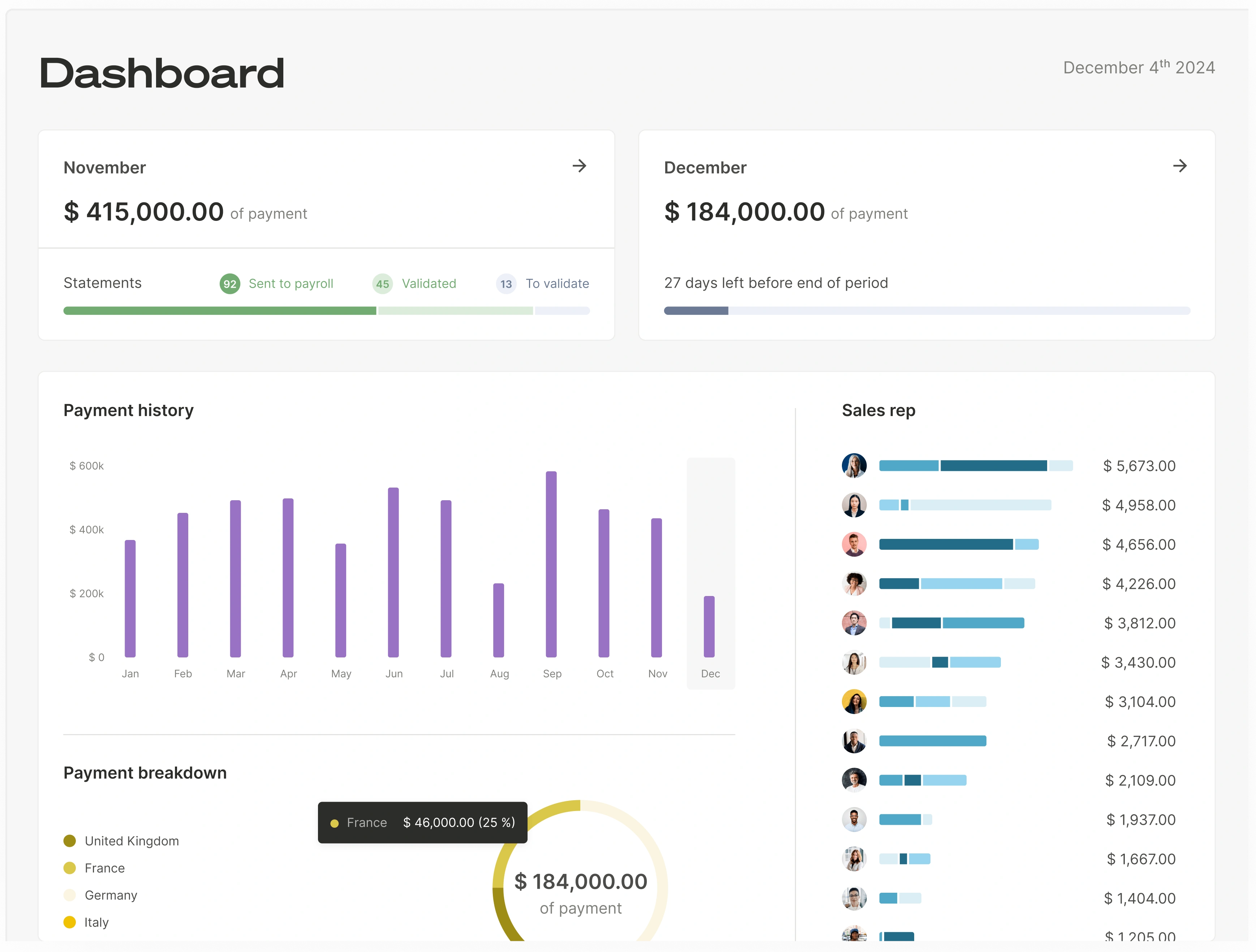
This is where specialized incentive management software like Qobra changes the game. Our platform automates the entire process, from data integration to payout calculation. With a no-code rule editor, companies can build and adjust even the most complex plans without needing developers. Qobra connects directly to your CRM (like Salesforce or HubSpot), syncs its data automatically throughout the day, and gives sales reps a live dashboard of their performance and potential earnings. This level of transparency eliminates disputes, saves countless administrative hours, and turns compensation into a true real-time motivator.
Measuring Performance and Avoiding Common Pitfalls
A compensation plan is a living document that should be reviewed and refined over time.
Continuous Monitoring and Reporting
Track plan performance against business outcomes. Are you seeing the desired behaviors? Is the plan driving revenue growth? Is the cost of sales within acceptable limits? Use dashboards to monitor key metrics and identify trends.
Identifying and Mitigating Risks
A poorly designed plan can have negative consequences.
- Gaming the System: Reps may focus on activities that maximize their payout but don't benefit the company long-term (e.g., heavily discounting to close a deal at month-end).
- Unhealthy Competition: An overly individualistic plan can discourage teamwork and knowledge sharing.
- The Importance of Fairness: Perceived unfairness in quotas or payouts can quickly demotivate an entire team. Consider implementing mechanisms like clawback clauses to reclaim commissions on deals that are canceled or default shortly after closing.
Warning: Set and Forget at Your Peril
Market conditions, business strategies, and product offerings change. A compensation plan that was effective last year may be obsolete today. Commit to reviewing your plan at least annually—or even quarterly—to ensure it remains aligned with your current business objectives and continues to motivate your team effectively.
Legal and Compliance Considerations
Ensure your plan complies with all relevant employment laws. Be particularly mindful of the legal obligations when modifying variable pay, as changes often require employee consent. Consult with legal counsel to review your plan documents and ensure they are enforceable and fair.
A strategic variable compensation plan is one of the most powerful investments a company can make in its go-to-market strategy. By moving beyond manual processes and embracing clarity, alignment, and modern tools, you can transform compensation from a simple expense into a dynamic driver of growth and performance.
Frequently Asked Questions (FAQ)
What is the main difference between a bonus and a commission?
A commission is typically a percentage of a transaction value and is paid out incrementally as sales are made. It's directly tied to an individual's sales volume. A bonus is usually a fixed, lump-sum amount paid for achieving a specific, pre-defined objective that may or may not be directly tied to revenue (e.g., completing a project, achieving a team goal).
How is On-Target Earnings (OTE) calculated?
OTE is the sum of an employee's annual base salary and their target variable compensation (what they would earn for hitting 100% of their quota). For example, if an employee has a base salary of $80,000 and a target variable of $60,000, their OTE is $140,000.
What is a good pay mix (base vs. variable) for a sales role?
The ideal pay mix depends on the role's direct influence over a sale. An Account Executive, whose primary job is closing deals, might have a 50/50 or 60/40 mix (base/variable). A Sales Engineer or a Customer Success Manager, who supports the sales process but doesn't own the final close, might have a 75/25 or 80/20 mix.
How often should we review and update our variable compensation plan?
It's a best practice to review your compensation plan at least once a year. However, if your company undergoes significant changes—such as a major strategy pivot, new product launch, or market entry—you should review the plan immediately to ensure it remains aligned with the new objectives.
Once your plan and KPIs are set, a variable compensation software runs the calculations in real time and syncs with your CRM.