Sales Compensation Software Benchmark | Compare 15+ Sales Compensation Platforms
Download
- Revenue operations software sits on top of the CRM: the CRM tracks contacts, deals and sales calls, while RevOps software turns that data into automated workflows across sales, marketing and customer success, from a single source of truth.
- RevOps tools fall into four categories: revenue intelligence and forecasting (Gong, Clari, Weflow, Forecastio), data management and operations hubs (HubSpot Operations Hub, Cognism, Coefficient), sales compensation and commission management (Qobra), and deal management and customer collaboration (RevOps.io, Dock).
- Commission automation is rarely covered by generalist RevOps tools; Qobra's sales compensation platform fills that gap by reading from the same CRM and warehouse sources and connecting CRM data from Salesforce or HubSpot directly to commission calculations.
- Qobra fits mid-market RevOps teams that want commission management inside their RevOps stack: Qobra combines native Salesforce and HubSpot integrations with a no-code plan builder, and aims to eliminate commission errors and build trust with sales reps through transparency.
- In a RevOps stack, a deal marked Closed-Won in the CRM should automatically trigger workflows for customer onboarding, commission calculation and financial reporting, which is why RevOps software needs native integrations with the CRM, marketing automation and financial systems.
Are your sales, marketing, and customer success teams operating on different planets? Do you spend more time questioning the accuracy of your CRM data than using it to make strategic decisions? If you're grappling with disjointed processes, unreliable forecasts, and a leaky revenue funnel, you're not alone.
Gartner (1) has predicted that a large majority of the highest-growth companies would adopt a RevOps model. For sales leaders building toward sustained revenue growth, choosing the right revenue operations software is no longer optional.
It's about more than just buying another tool; it's about fundamentally rethinking how your business generates revenue. Let's explore the world of RevOps software and find the right solutions to optimize your entire revenue lifecycle.
What is revenue operations software?
Revenue operations software is a category of platforms designed to unify sales and marketing processes, customer success data, and revenue data into a single operational layer. It gives revenue operations teams the visibility, automation, and data quality they need to drive consistent, predictable growth across the entire customer lifecycle.
Unlike standalone CRM or marketing tools, revenue operations tools connect every part of the revenue engine — from pipeline management to post-sale expansion — making it possible for revenue teams to operate from a single source of truth and make confident, data-driven decisions.
Understanding the RevOps Revolution
At its core, Revenue Operations (RevOps) is a strategic business function that aims to align sales team, marketing, and customer service operations across the full customer lifecycle to drive revenue growth. It breaks down the traditional silos between these departments to create a single, unified commercial engine. The goal is to maximize a company's revenue potential by improving processes, standardizing metrics, and leveraging technology to create a more efficient and predictable revenue machine.
This alignment is powered by a central nervous system: revenue data. A successful RevOps strategy ensures that all teams are working from the same playbook, looking at the same key metrics, and pulling in the same direction, providing end-to-end visibility into customer behavior, from initial awareness to long-term loyalty.
This unified approach provides end-to-end visibility into the customer journey, from initial awareness to long-term loyalty. It moves businesses away from disconnected departmental goals (e.g., marketing's lead volume, sales's closed deals) and toward a shared objective: sustainable revenue growth.
In today's competitive B2B landscape, a fragmented experience breaks the consistent customer journey buyers expect. RevOps ensures a smooth, consistent journey for the buyer, which in turn improves conversion rates, accelerates the sales cycle, and increases customer lifetime value.
Key benefits of revenue operations software
Eliminate manual work at scale
Commission calculations, pipeline updates, data entry, reporting — these tasks consume hours every week across revenue operations teams. RevOps software automates these processes in the background, freeing sales teams to focus on selling and ops teams to focus on strategy rather than reconciliation.
Improve sales performance across the board
When sales performance data is scattered across multiple tools, coaching is reactive and quota-setting is guesswork. A RevOps platform centralizes execution data — activity levels, conversion rates, deal velocity — giving sales leaders the visibility to intervene early and replicate what top performers do consistently.
Predict revenue outcomes with confidence
One of the most tangible benefits of RevOps software is the ability to predict revenue outcomes rather than react to them. By combining pipeline management data, historical close rates, and customer behavior signals, the platform produces forecasts that Finance and leadership can actually rely on when making budget and headcount decisions.
Build the foundation for sustained revenue growth
Scaling a business without operational infrastructure means adding complexity with every new rep, market, or product line. RevOps software creates the repeatable processes and data quality standards that make sustained revenue growth possible — without the overhead growing at the same pace. The result is a consistent customer journey that holds as the business evolves.
💡 These benefits are not theoretical. Multiple industry studies show that companies with mature RevOps practices achieve 2.4x higher revenue growth and 2x higher profitability growth compared to less aligned organizations (2).
Key Features to Look for in a RevOps Platform
Choosing the right technology is critical for enabling your RevOps strategy. While the term "RevOps software" is broad, the best solutions share common characteristics designed to unify your tech stack and streamline processes. When evaluating platforms, look for a combination of these core functionalities.
Data Integration and Management
Your RevOps platform must act as a central hub, seamlessly connecting to your CRM, marketing automation platform, financial systems, and other critical tools. Look for features like automated data sync, data cleansing automation, and a command center that provides a single view of data quality. This ensures everyone is working with clean, reliable revenue data and the foundation for sound data analysis across all teams.
Process Automation and Workflow Building
The software should allow you to automate cross-departmental handoffs and repetitive tasks. For example, when a deal is marked "Closed-Won" in the CRM, it should automatically trigger workflows for customer onboarding, commission calculation, and financial reporting. Strong automation is what allows revenue teams to operate at scale without adding headcount.
Analytics, Reporting and Revenue Intelligence
Finally, robust analytics and reporting are non-negotiable. The platform should provide deep insights into every stage of the revenue funnel. This includes revenue intelligence to analyze sales calls, attribution models to measure marketing ROI, and advanced forecasting tools that go beyond simple pipeline projections. A unified view of performance allows you to track execution, identify bottlenecks, and make data-driven decisions with confidence.
The Critical Role of Commission Automation in RevOps
One of the most powerful levers in aligning your revenue teams is their compensation. If sales reps can't trust their commission statements or have no visibility into their potential earnings, motivation plummets and disputes arise. This is where specialized commission management software becomes a cornerstone of any effective RevOps stack.
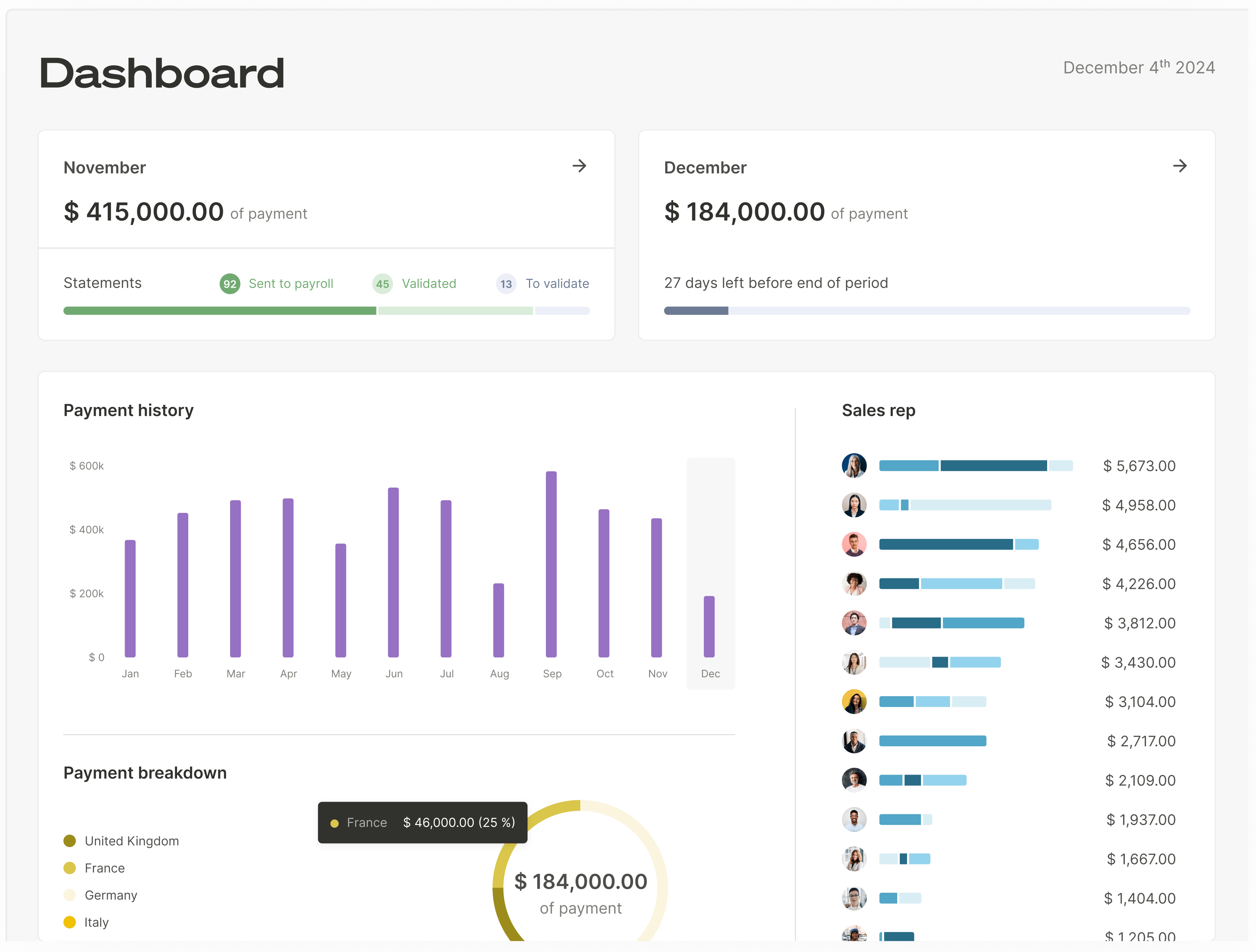
Manually calculating commissions on spreadsheets is not only time-consuming but also prone to errors that erode trust and create friction between Sales, Ops, and Finance. Our platform is designed to eliminate these challenges entirely. By integrating natively with your CRM (like Salesforce or HubSpot), we automate the entire commission process. Qobra syncs CRM data automatically throughout the day, and on demand in one click. Each commission is calculated from that CRM data, which gives your sales reps clear visibility into their earnings.
With our 100% no-code plan editor, you can build and deploy even the most complex compensation plans, spiffs, and bonuses in minutes. The system provides a complete audit trail for every calculation, ensuring that Finance can validate every payment with confidence. This level of transparency and reliability transforms compensation from a contentious administrative task into a powerful strategic tool for driving performance and aligning your entire revenue team. It's a key part of creating a truly cohesive and motivated commercial organization.
A Tour of the RevOps Software Landscape
The market for RevOps solutions is vast, with tools specializing in different aspects of the revenue lifecycle. Building the right tech stack often involves combining a few best-in-class platforms that integrate seamlessly. Here are some of the top categories and tools to consider for your sales operations and mid-sized tech company.
Revenue Intelligence and Forecasting
These platforms analyze customer interactions and pipeline data to provide actionable insights and more accurate forecasts. For a detailed comparison of the leading tools in this category, see this overview of revenue intelligence platforms.
- Gong: A leader in conversation intelligence, Gong records and analyzes sales calls, meetings, and emails using AI. It helps RevOps teams identify winning talk tracks, coach reps more effectively, and understand customer behavior and market trends based on real sales interactions.
- Clari: Clari combines revenue operations, sales engagement, and conversation intelligence to provide a comprehensive view of the revenue process. It excels at pipeline inspection and AI-driven revenue forecasting, helping leaders spot risks and opportunities in real-time.
- Weflow: Weflow focuses on improving CRM data quality, sales process adherence, and forecasting accuracy. It helps automate data entry, provides customizable pipeline views to identify bottlenecks, and uses templates to streamline discovery and qualification.
- Forecastio: Forecastio is an AI-powered revenue intelligence platform for HubSpot teams that improves forecast accuracy and deal execution. AI agents assess pipeline health, recommend next selling steps, and run win/loss analysis, so RevOps teams can act on revenue risks before the quarter closes.
Data Management and Operations Hubs
These tools focus on syncing, cleaning, and operationalizing your customer data across your entire tech stack.
- HubSpot Operations Hub: Designed as a unified platform for RevOps professionals, it helps sync and clean customer data, integrate apps, and build custom reports from one central CRM. Its programmable automation feature allows you to build sophisticated, tailored workflows.
- Cognism: While primarily a sales intelligence platform, Cognism provides high-quality B2B data that is essential for RevOps. It enables teams to enrich their CRM data, calculate their total addressable market (TAM), and improve lead segmentation, scoring, and routing.
- Coefficient: This no-code solution connects your Google Sheets to your business systems (CRM, databases, etc.), allowing you to work with live data and automate spreadsheet tasks. It’s perfect for creating real-time dashboards and reports without leaving the familiar spreadsheet environment.
Sales Compensation and Commission Management
As discussed, this is a critical component for motivating and aligning sales teams.
- Qobra: Our platform automates the entire sales commission lifecycle. With native CRM integrations, a flexible no-code plan builder, and real-time calculation visibility, we empower Sales, Ops, and Finance teams. The focus is on eliminating errors, building trust with sales reps through transparency, and turning compensation into a strategic driver of growth and performance. Explore how a pay-for-performance model can be accurately managed with automation.
Deal Management and Customer Collaboration
These tools streamline the final stages of the sales process and the transition to customer success.
- RevOps.io: This platform is a modern Deal Desk, approvals, and Configure, Price, Quote (CPQ) solution. It helps sales teams create error-free deals from templates, automate approval workflows, and collaborate effectively to close deals faster.
- Dock: Dock is a customer-facing platform that creates digital sales rooms. It allows sellers to collaborate with buyers in a centralized workspace, sharing action plans, content, and order forms. This streamlines the buying experience, ensures a consistent customer journey, and improves the sales-to-success handoff.
💡 Expert Advice
Don't try to boil the ocean. Start your RevOps software journey by identifying the single biggest point of friction in your revenue process. Is it inaccurate forecasting? Manual commission disputes? A messy CRM? Solve that problem first with a best-in-class tool. A successful initial implementation will build momentum and create a strong foundation for expanding your RevOps tech stack over time.
How to Select the Right RevOps Software for Your Business
With so many options available, choosing the right tools can feel overwhelming. A structured evaluation process will help you make an informed decision that aligns with your specific business needs.
First and foremost, start with the problem, not the product. Before you even look at a demo, clearly define the specific challenges you're trying to solve.
- Are you struggling with lead routing?
- Is your sales pipeline visibility too limited to forecast accurately?
- Is your commission process causing disputes?
Identifying your primary pain points will narrow your search and prevent you from being distracted by flashy features you don't need. An honest assessment of your current sales operations for startups or scale-ups is the best starting point.
Next, prioritize integration capabilities. A RevOps tool is only as good as its ability to communicate with the rest of your tech stack. Ensure any potential solution offers native, deep integrations with your CRM (e.g., Salesforce, HubSpot), your marketing automation platform, and your HRIS, with a reliable way to send data to payroll. Automatic data synchronization is crucial; manual data entry defeats the purpose of an aligned RevOps function.
Finally, consider scalability and support. Your business is going to grow, and your software needs to grow with you.
- Can the platform handle larger data volumes?
- Can you easily add users and customize functionality as your processes evolve?
Also, evaluate the vendor's implementation process and ongoing support.
- Do they provide comprehensive training?
- Is their support team responsive and knowledgeable?
A strong partnership with your software vendor is key to long-term success.
📌 To Note
When evaluating pricing, look beyond the per-seat license fee. Ask about implementation costs, platform fees, and potential charges for additional integrations or data storage. Understanding the total cost of ownership (TCO) will help you build a realistic budget and avoid unexpected expenses down the line. Many modern platforms offer packages tailored to different business sizes, so be sure to discuss your growth plans with their sales team.
Overcoming Common Implementation Hurdles
Most RevOps implementations run into the same three obstacles. Here's what to expect and how to handle each one.
One of the biggest hurdles is securing buy-in from all stakeholders. RevOps affects multiple departments, and it's essential to involve leaders from sales, marketing, finance, and customer success from the very beginning. Clearly communicate the "why" behind the change, focusing on the specific benefits each team will experience.
Data migration and hygiene is another common challenge. Moving data from legacy systems or messy spreadsheets into a new platform can be complex. Allocate sufficient time for a data cleanup project before you begin implementation. This is a perfect opportunity to standardize data fields and establish clear governance rules, ensuring you start with a clean slate. Adhering to standards like ASC 606 for commissions becomes much easier with clean, reliable data.
Finally, be prepared for a learning curve. Even the most intuitive software requires training and adoption. Develop a comprehensive onboarding plan that includes hands-on training sessions, clear documentation, and designated "champions" within each team who can provide peer support. Celebrate early wins and share success stories to build momentum and encourage widespread adoption. Keeping up with the latest sales technology trends can also help your team stay ahead.
The journey to a fully optimized revenue operation is a marathon, not a sprint. By selecting the right software and thoughtfully managing its implementation, you can build a powerful, aligned engine that drives predictable and sustainable growth for years to come. It starts with a clear strategy, a commitment to breaking down silos, and the right technology to bring it all together.
What is the difference between RevOps and traditional sales tools?
The primary difference lies in their scope and focus. Traditional sales tools are built specifically to support tasks within the sales department, such as pipeline management, lead prospecting, or sales engagement. Their focus is narrow, providing limited visibility into pre-sale (marketing) or post-sale (customer success) activities. RevOps tools, on the other hand, are designed to cover the entire revenue cycle. They provide end-to-end visibility into the customer journey and are built for cross-functional use by sales, marketing, and customer success teams. RevOps platforms often include features that facilitate collaboration and automate handoffs between these teams, creating a single source of truth for all revenue-generating activities.

Commission automation, listed above as a critical RevOps capability, is rarely covered by generalist RevOps tools. Qobra's sales compensation platform fills that gap while reading from the same CRM and warehouse sources.
FAQ - Revenue operations software
What is the difference between revenue operations software and a CRM?
A CRM is the data foundation — it tracks contacts, deals, and sales calls. Revenue operations software sits on top of it, turning that data into automated workflows across sales, marketing, and customer success. Tools like Qobra extend this further by connecting CRM data directly to commission calculations.
How does revenue operations software improve sales compensation management?
Manual commission processes are error-prone and time-consuming. RevOps software automates the link between deal data and payout, giving reps real-time visibility into their earnings and giving sales leaders the confidence that sales performance is rewarded accurately. Qobra was built specifically for this use case.
How do you know when your business is ready for revenue operations software?
Three signals: your teams work from different data sources, you can no longer predict revenue outcomes reliably, and manual processes are consuming hours that should go toward growth. If any of these apply, RevOps software is the next logical step