Sales Compensation Software Benchmark | Compare 15+ Sales Compensation Platforms
Download
- Incentive compensation directly connects employee performance to business results, helping companies improve motivation, retention, and overall sales performance.
- There is no one-size-fits-all incentive compensation program. The most effective plans combine commissions, bonuses, equity, and team-based incentives depending on company goals and employee roles.
- Poorly managed compensation processes often create calculation errors, lack of transparency, and administrative overload, especially when companies rely on spreadsheets and manual workflows.
- Modern incentive compensation management software helps automate calculations, centralize compensation data, improve visibility, and reduce operational complexity for Finance, RevOps, HR, and Sales teams.
- Transparent and well-structured incentive compensation management tools not only motivate employees through direct financial rewards but also strengthen trust, alignment, and long-term business growth.
Are your incentive plans truly motivating your top performers, or just causing confusion and disputes? How much time do your Ops and Finance teams lose each quarter buried in spreadsheets, manually calculating commissions and correcting errors? If you're looking for a way to build compensation structures that are clear, fair, and directly aligned with your business goals, you're in the right place. It's time to move beyond guesswork and create a system that fuels growth, retains talent, and gives everyone, from sales reps to the C-suite, perfect visibility.
What is Incentive Compensation and Why Does it Matter?
Incentive compensation is a performance-based pay structure designed to reward employees for achieving specific goals that align with company objectives. Incentive based compensation allows companies to directly connect employee rewards with measurable business outcomes and performance objectives.
Unlike a fixed salary, which rewards presence, this variable component ties an employee's earnings directly to their impact and outcomes. The core idea is simple: when employees contribute to the company's success, they share in the rewards.
In today's competitive landscape, a well-designed incentive program is more than just a "nice-to-have", it's a strategic lever for growth. According to the Incentive Research Foundation, companies that implement structured incentive plans see an average productivity boost of 22%. This isn't just about making employees work harder; it's about making them work smarter by focusing their efforts on what matters most to the business.
A strong incentive strategy achieves several critical objectives:
- Aligns Pay with Performance: It creates a direct link between an employee's contribution (e.g., revenue growth, customer retention, project delivery) and their financial reward.
- Boosts Motivation and Retention: Meaningful rewards tailored to different roles can significantly improve job satisfaction and loyalty. When top performers feel their efforts are recognized and fairly compensated, they are far more likely to stay.
- Reduces Fixed Costs: By shifting a portion of compensation to a variable model, companies can scale rewards with business results. This creates financial flexibility, especially in volatile markets or early-stage growth phases.
However, the effectiveness of any plan hinges on its design and management. Clunky, manual processes built on spreadsheets often lead to errors, delays, and a lack of trust. This is where modernizing your approach becomes essential. Moving to a dedicated platform to automate calculations and provide real-time visibility ensures accuracy and transparency, turning compensation from a source of friction into a powerful motivator.
Key components of an incentive compensation plan
A strong incentive compensation plan should not only define what employees can earn. It should also clarify the rules that protect the company, ensure fairness, and keep payouts financially sustainable.
Common components include payout thresholds, which define the minimum level of performance required before incentives are paid, and accelerators, which increase rewards when employees exceed targets. Companies may also use caps to limit maximum payouts or clawbacks to recover bonuses paid on inaccurate results, contract cancellations, or misconduct.
Finance teams should also model the plan budget before launch. This means estimating payout exposure across different performance scenarios, from underperformance to overachievement, to avoid unexpected compensation costs during peak sales cycles.
A Comprehensive Look at the Types of Incentive Compensation
There is no one-size-fits-all solution for incentive pay. The right model depends on the role, the team's function, company maturity, and specific business goals. What motivates a quota-carrying sales rep won't be the same for a backend engineer or a customer success manager. Understanding the various types of incentive compensation plans is the first step toward building a tailored and effective strategy.
Direct Performance-Based Incentives
These plans are most common in roles where individual output is directly measurable and tied to revenue or other key metrics. They are designed to drive specific, high-impact behaviors.
- Commission-Based Incentives: This is the most traditional form of sales compensation. Employees earn a percentage of the revenue they generate from sales. It’s straightforward, highly motivating for sales roles, and directly links effort to reward. It's best for sales teams, business development reps, and channel partners. For a deeper dive, explore our guide to B2B sales commission structures.
- Sales Incentive Plans (SIPs): More sophisticated than straight commission, SIPs are structured programs with pre-set quotas, accelerators for over-performance, and multi-tiered payout curves. They often include bonuses for strategic goals like selling a new product, maintaining high margins, or landing key accounts. SIPs are ideal for account executives and sales leadership whose performance is measured against complex targets.
- Goal-Based Bonuses: These are tied to achieving specific, predefined objectives, often based on OKRs (Objectives and Key Results) or KPIs. Unlike sales-focused plans, they are highly adaptable across different functions like marketing (e.g., generating a certain number of MQLs), operations (e.g., reducing production time), or product development (e.g., launching a new feature on schedule).
- Milestone-Based Bonuses: These bonuses are paid upon the completion of significant project phases or deliverables. This model is perfect for motivating cross-functional teams working on long, complex projects, such as a major software release, an infrastructure rollout, or achieving a critical compliance certification. It's highly effective for product, engineering, and R&D teams.
Company-Wide & Collaborative Incentives
These incentives are designed to foster teamwork, align the entire organization around common goals, and reward collective success.
- Profit-Sharing Plans: In this model, a portion of the company's profits is distributed among employees. The payout, typically made quarterly or annually, can be a percentage of salary or a fixed amount. Profit-sharing cultivates a sense of shared ownership and encourages everyone to think about the company's bottom line. It's best suited for mature companies with stable profitability.
- Gainsharing: Often confused with profit-sharing, gainsharing is more focused. It rewards teams or departments for improvements in operational efficiency, such as cost savings, quality enhancements, or productivity gains. A baseline is set using historical data, and a portion of the financial "gain" from improvements is shared with the employees responsible. This is ideal for manufacturing, logistics, and customer service teams.
- Team-Based Incentives: This approach rewards a group for its collective performance rather than individual output. Incentive plans can be structured around individual or team performance depending on the company’s objectives and collaborative culture. The reward, whether a cash bonus, pooled equity, or a team experience, is distributed among members based on achieving a shared goal. This model is excellent for agile squads and cross-functional project teams where collaboration is paramount to success.
Profit-Sharing vs. Gainsharing:
The key difference lies in the scope. Profit-sharing is tied to the entire company's profitability, a metric influenced by many external factors. Gainsharing is tied to a team's direct influence over specific operational metrics (like costs or productivity), giving them more control over the outcome.Long-Term & Equity-Based Incentives
Designed primarily for retention, these plans reward employees for their sustained contribution over multiple years, aligning their personal success with the company's long-term value.
- Long-Term Incentive Plans (LTIPs): LTIPs offer financial rewards based on performance over a period of two to five years. Payouts are tied to achieving major strategic goals, such as hitting a specific EBITDA target, stock price appreciation, or market share growth. They are commonly used for executive leadership and key strategic hires to ensure focus on sustainable growth.
- Stock Options & Equity-Based Plans: Granting employees ownership in the company is a powerful retention tool. This can take the form of stock options (the right to buy shares at a predetermined price), RSUs (Restricted Stock Units), or ESOPs (Employee Stock Ownership Plans). Common in startups and tech companies, equity aligns employees with shareholder interests and rewards them for helping grow the company's value over the long term.
Non-Monetary & Other Incentives
Not all motivation is financial. These incentives focus on recognition, work-life balance, and professional development.
- Non-Monetary Incentives: These rewards include public recognition, flexible work schedules, extra paid time off, wellness benefits, professional development opportunities, or unique team experiences. When implemented thoughtfully, these perks can be just as powerful as cash, especially in culture-driven organizations. They are a great way to differentiate between non-monetary compensation and monetary compensation.
- Spot Bonuses: These are immediate, on-the-spot rewards given for exceptional contributions, such as resolving a major customer crisis or going above and beyond on a key project. They are unplanned but highly effective for reinforcing positive behaviors in the moment.
- Vouchers and Gift Cards: A simple yet effective non-monetary incentive that gives employees the flexibility to choose their own reward.
| Incentive Type | What It Rewards | Ideal For |
|---|---|---|
| Commission-Based | Individual sales performance | Sales teams, BD reps, channel partners |
| Profit-Sharing Plans | Overall company profitability | Mature companies, flat organizations |
| Gainsharing | Team productivity & efficiency gains | Operations, logistics, manufacturing |
| Spot Bonuses | Exceptional one-time achievements | All functions, culture-first companies |
| Sales Incentive Plans | Quota attainment, strategic sales goals | Account executives, quota-carrying reps |
| Goal-Based Bonuses | Achieving defined OKRs or KPIs | Marketing, product, growth teams |
| Long-Term Incentive Plans | Multi-year strategic goal achievement | Executives, strategic hires |
| Stock Options/Equity | Long-term value creation & ownership | Startups, tech companies, senior hires |
| Milestone-Based Bonuses | Major project or product delivery | Product, engineering, R&D teams |
| Team-Based Incentives | Collaborative team outcomes | Agile and cross-functional teams |
| Non-Monetary Incentives | Value-aligned behavior, effort, culture fit | People-first organizations |

The Pros and Cons of Incentive Pay
When designed and managed correctly, incentive pay can be a powerful tool. However, a poorly constructed plan can have unintended negative consequences. It's crucial to understand both sides of the coin.
Advantages of Incentive Compensation
Improves Employee Productivity
A clear link between performance and reward is a powerful motivator. When employees know that meeting specific goals will result in a bonus or commission, they are more likely to focus their efforts and work efficiently to achieve them. This creates a positive feedback loop that encourages continuous high performance.
Increases Employee Retention
Feeling valued is a key driver of employee loyalty. Incentive pay is a tangible way to show appreciation for hard work and significant contributions. Organizations that recognize and reward their top performers are better able to retain them, avoiding the high costs associated with turnover and hiring. A strong pay-for-performance model can be a cornerstone of your retention strategy.
Enhances Organizational Climate
Well-designed incentive programs can strengthen company culture. Team-based incentives, for instance, foster collaboration and break down silos as employees work together toward a common goal. Public recognition tied to spot bonuses can also boost morale and create a positive, appreciative work environment.
Disadvantages of Incentive Compensation
Can Provide Only Short-Term Benefits
If not structured carefully, incentives can create a "tunnel vision" mentality. Employees may focus exclusively on the specific metrics tied to their pay, neglecting other important aspects of their role like creativity, innovation, or long-term customer relationships. This can lead to burnout and a transactional work culture.
May Affect Ethical Behavior
Intense pressure to hit targets can sometimes lead to unethical behavior. Employees might be tempted to cut corners, misrepresent sales figures, or push low-quality deals at the end of a quarter just to earn a bonus. This risk underscores the importance of a strong ethical culture and balanced performance metrics.
Can Create an Unhealthy Work Environment
If incentives are perceived as unfair or create a zero-sum game, they can foster unhealthy competition. This can lead to jealousy, information hoarding, and conflict between coworkers. Ensuring plans are transparent and promote fair compensation is critical to avoiding this pitfall.
How to Design an Effective Incentive Compensation Plan
Knowing the different types of incentives is only the beginning. The real value comes from designing and implementing a plan that is tailored to your business. To design an incentive compensation plan effectively, companies need to align rewards with business objectives, employee motivation, and operational realities. Here are the essential steps to create a program that motivates performance and drives results.
Step 1: Set Clear Business Objectives
Your incentive plan should be a direct reflection of your company's strategic priorities. Before designing any program, ask: what are the top 3 outcomes we need to achieve this year? Examples could include accelerating revenue growth, reducing customer churn, or improving product delivery speed. Once you've identified these goals, map them to the teams that have the most direct influence over them.
Step 2: Define Measurable Performance Indicators
Incentives must be tied to metrics that are clear, trackable, and within the employee's control. Vague goals lead to confusion and demotivation.
- For sales, this could be Annual Recurring Revenue (ARR) or new logos acquired.
- For marketing, it might be Marketing Qualified Leads (MQLs).
- For customer success, Net Promoter Score (NPS) or Net Revenue Retention (NRR) are common.
Ensure each metric can be measured consistently (e.g., monthly or quarterly) and is directly linked to a business outcome. Analyzing key sales metrics for SaaS companies can help you select the right indicators.
🚨 Attention
Avoid "vanity metrics." A metric might look impressive, but if it doesn't correlate with a real business outcome, rewarding it is a waste of resources. For example, rewarding a marketing team for website traffic alone is less impactful than rewarding them for qualified leads that convert to sales.
Step 3: Segment Employees and Choose the Right Incentive Type
A one-size-fits-all plan rarely works. Different roles contribute value in different ways and require different motivational structures. Segment your employees by function and align the incentive type accordingly. An SDR might have a simple bonus structure based on meetings booked, while an Enterprise Account Executive will need a more complex SIP with accelerators and kickers for multi-year deals. Early-stage startups might lean on equity to conserve cash, while established enterprises can offer a mix of cash bonuses and LTIPs.
Step 4: Establish Plan Governance and Communication
Even the best-designed plan will fail without clear ownership and transparent communication. Misunderstanding leads to mistrust and disengagement.
- Ownership: Assign a person or team (often RevOps or HR) to own the design, updates, and administration of incentive plans.
- Cadence: Establish a regular review cycle (e.g., quarterly check-ins, annual overhaul) to ensure plans remain aligned with shifting business priorities.
- Communication: Create a simple, one-page document for each team that explains their plan in plain language. Host Q&A sessions to address concerns and use real examples to show how payouts are calculated. The ultimate goal is achieving what is pay transparency: a state where every employee understands how their compensation works.
Step 5: Monitor, Adjust, and Automate
No plan is perfect from the start. Treat your compensation strategy as a living system, not a static document. Track plan performance against intended outcomes. Did quota attainment increase? Did churn decrease? Gather feedback through surveys and manager 1-on-1s.
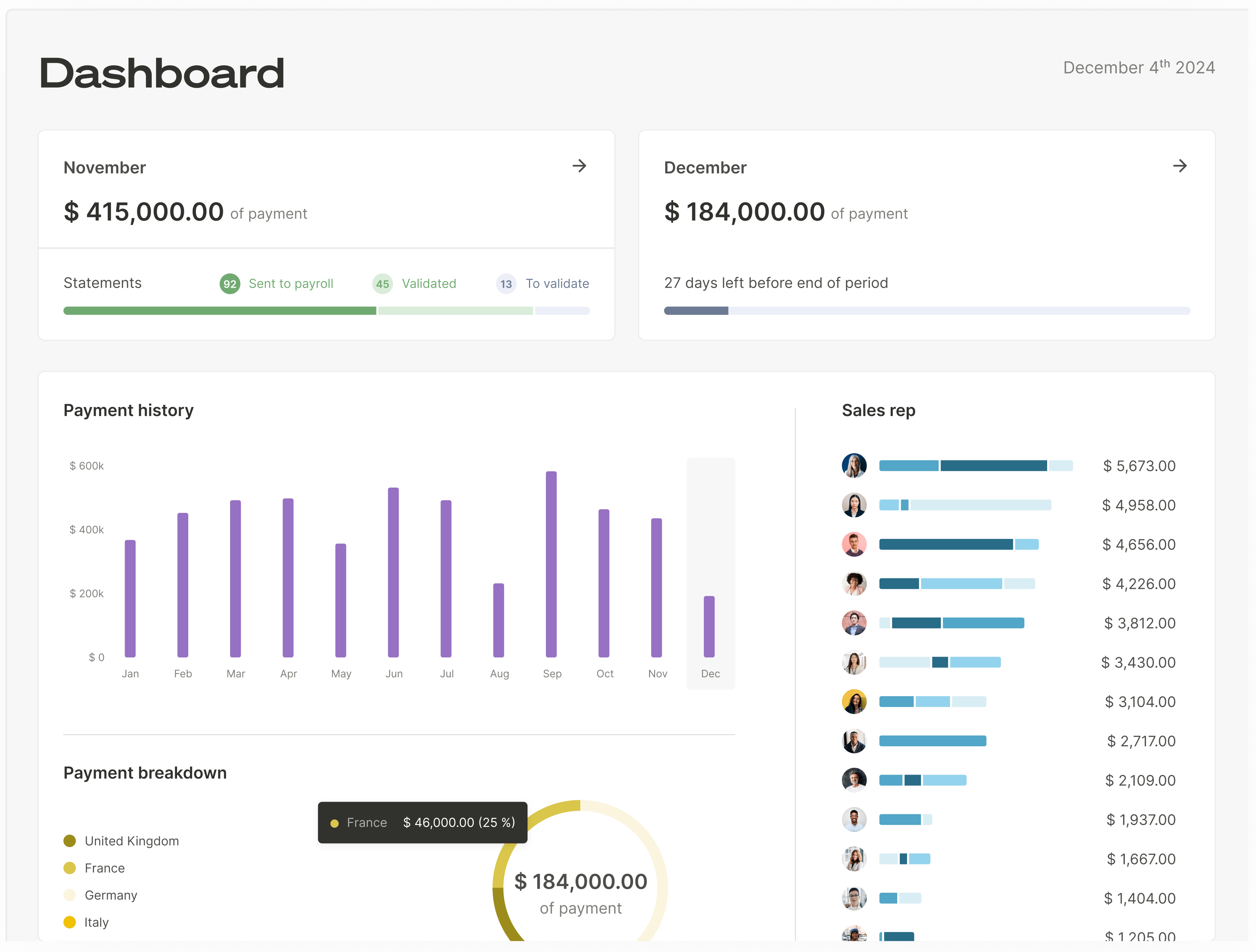
Most importantly, automate the process. Manually managing commissions on spreadsheets is inefficient, error-prone, and lacks transparency. A dedicated platform like Qobra automates the entire cycle:
- Automatic data sync with your CRM (like Salesforce or HubSpot), throughout the day and on demand in one click, eliminates manual data entry.
- A no-code plan editor allows you to build and adjust complex plans without engineering resources.
- Instant calculations and dashboards give sales reps full visibility into their earnings, motivating them in real-time.
- Automated workflows and audit trails provide Finance and Ops with the control and reliability needed to ensure accurate and compliant payments.
💡 Expert Advice
The single biggest failure point in incentive compensation is not the plan itself, but the communication around it. When you roll out a new plan, don't just send an email. Hold a kickoff meeting, provide clear documentation with examples, and give managers the tools to answer their team's questions. A plan that isn't understood is a plan that won't motivate.
Choosing the right incentive is about aligning your company's goals, culture, and financial reality. It’s about understanding that what drives a sales team focused on quarterly quotas is different from what motivates an engineering team working on long-term innovation. The key is not to find the most popular incentive but to find the right combination for your unique business.
By moving away from manual, opaque processes and embracing a clear, automated, and transparent approach, you transform compensation from an administrative burden into your most powerful strategic lever for growth. Platforms like Qobra are designed to bring this clarity and automation to high-growth teams, ensuring your incentive plans are not just calculated correctly, but are structured to drive the behaviors that matter most.
What are the most common mistakes to avoid when designing incentive plans?
When creating or refining incentive plans, several common pitfalls can undermine their effectiveness. Avoiding them is key to building a program that motivates rather than demotivates. The most frequent mistakes include:
Overly Complex Plans
If an employee needs a Ph.D. in mathematics to understand their commission statement, your plan is too complicated. Complexity breeds confusion and mistrust. Aim for simplicity and clarity.
Misaligned Goals
Tying incentives to metrics that don't directly support strategic business objectives. This can lead to teams optimizing for the wrong outcomes, creating activity without impact.
Poor Communication
Rolling out a plan without properly explaining the "why" behind it and the "how" it works. Lack of clear communication is a primary driver of disputes and disengagement.
One-Size-Fits-All Approach
Applying the same incentive structure across wildly different roles (e.g., giving a product manager a sales-style commission plan). This ignores the unique ways different teams create value.
Setting Unrealistic Targets
Quotas or goals that are perceived as unattainable will demotivate employees from the start. Goals should be challenging but achievable.
Neglecting Non-Performers
While plans should reward top performers, they should also create a path for middle performers to improve. A plan where only the top 5% can win can demoralize the majority of the team.
Failing to Automate
Sticking with manual spreadsheets for commission management as the company scales. This inevitably leads to errors, payment delays, and a massive administrative burden, eroding trust in the entire process.
Incentive compensation management challenges
Despite the clear benefits of incentive compensation, managing these programs efficiently remains a major challenge for many organizations. Before the rise of modern incentive compensation management software, most companies relied heavily on spreadsheets, disconnected systems, and manual calculations to determine payouts. Even today, many businesses still operate with outdated processes that create inefficiencies, calculation errors, and a lack of transparency.
As compensation plans become more sophisticated, managing them manually becomes increasingly difficult. Organizations often need to handle multiple commission structures, bonuses, accelerators, quotas, and regional compensation rules simultaneously. Without integrated incentive compensation management tools, maintaining accurate and reliable data across Finance, RevOps, HR, and Sales teams can quickly become overwhelming.
Another major challenge is balancing complexity with clarity. Incentive plans must be detailed enough to reflect business priorities while remaining simple enough for employees to understand. When compensation calculations lack visibility, employees may lose trust in the process, which can negatively impact employee performance, motivation, and overall sales performance.
Regulatory compliance and scalability also become more difficult as organizations grow. Updating plans manually to reflect changing market conditions, evolving business goals, or international compensation requirements can create significant administrative overhead. This is especially true for high-growth companies managing large volumes of compensation data across multiple systems.
For these reasons, investing in the right incentive compensation management software is critical.
Conclusion
A successful incentive compensation strategy should evolve alongside company goals, market conditions, and employee expectations. It’s about understanding that what drives a sales team focused on quarterly quotas is different from what motivates an engineering team working on long-term innovation. The key is not to find the most popular incentive but to find the right combination for your unique business.
By moving away from manual, opaque processes and embracing a clear, automated, and transparent approach, you transform compensation from an administrative burden into your most powerful strategic lever for growth. Platforms like Qobra are designed to bring this clarity and automation to high-growth teams, ensuring your incentive plans are not just calculated correctly, but are structured to drive the behaviors that matter most.
FAQ - Incentive compensation
What is incentive compensation?
Incentive compensation is a form of variable pay designed to reward employees for achieving specific performance goals. Unlike a fixed salary, it directly links earnings to measurable results such as revenue generation, quota attainment, customer retention, or operational performance.
What are the most common types of incentive compensation?
The most common types of incentive compensation include commissions, bonuses, profit-sharing plans, stock options, milestone bonuses, and team-based incentives. Companies often combine several compensation models depending on the role, business objectives, and desired employee behaviors.
Why is incentive compensation important for employee performance?
A strong incentive compensation program helps motivate employees by creating a direct connection between employee efforts and financial rewards. Well-designed plans can improve employee engagement, increase sales performance, encourage accountability, and align individual objectives with company goals.
What are the biggest incentive compensation management challenges?
Some of the most common challenges include managing complex compensation plans, ensuring payout accuracy, maintaining data consistency across systems, and providing enough transparency for employees. Many organizations also struggle with spreadsheet errors, manual calculations, and scaling compensation processes as teams grow.
What is incentive compensation software?
Incentive compensation management software helps companies automate the calculation, tracking, reporting, and administration of variable compensation plans. These platforms centralize compensation data, reduce manual work, improve transparency, and provide employees with real-time visibility into commissions and bonuses.
How do companies measure the success of an incentive compensation program?
Organizations typically evaluate incentive compensation programs using KPIs such as quota attainment, revenue growth, employee retention, payout accuracy, employee satisfaction, and overall sales performance. Companies also monitor whether compensation plans encourage the right long-term behaviors and business outcomes.
What makes an effective incentive compensation plan?
An effective incentive compensation plan should be transparent, easy to understand, aligned with company objectives, and based on measurable KPIs. The best incentive compensation plans balance motivation with fairness while remaining flexible enough to evolve with changing business priorities. Clear communication and reliable incentive compensation management tools are also critical for success.
Whichever incentive type you choose, incentive compensation management software turns the plan into automated, error-free payouts.