Webinar: The Biggest Release Sales Comp Has Ever Seen. Come See For Yourself (Wednesday, October 7)
Register
- Public USD pricing exists for two of the eight platforms: QuotaPath (Growth $35 per user per month plus a $525 monthly platform fee) and Spiff by Salesforce ($75 per user per month billed annually, plus $250 per month per additional external connector). Qobra, Visdum, CaptivateIQ, Everstage, Xactly Incent and Performio are quote-based (vendor websites, Sept 2026).
- Visdum is the vendor in this list whose positioning names ARR, MRR and NRR crediting, with ASC 606 amortization in its reporting (vendor website, Sept 2026). For the other seven, the ARR and MRR crediting wording is marked to validate in the table below.
- Billing and accounting systems named by vendors: QuotaPath (QuickBooks, Xero, Sage Intacct, NetSuite, Maxio, Chargebee), CaptivateIQ (NetSuite, Sage Intacct, QuickBooks Online, Xero, Stripe, Zuora), Everstage and Visdum (NetSuite, QuickBooks, Sage Intacct), Performio (NetSuite, SAP), Xactly Incent (NetSuite) (vendor websites, Sept 2026).
- Published go-live times: Visdum 0.65 months on average, Everstage 2.5 months on average (some teams live in 7 weeks), Performio 4 to 8 weeks, QuotaPath 45 to 60 days on the Growth plan, Qobra weeks for a US mid-market team; Xactly Incent usually takes several months with a system integrator (vendor websites, Sept 2026).
- Qobra is headquartered in New York and Paris, manages $1B+ in commissions across 300+ companies (qobra.co) and is rated 4.8/5 on G2 (1,071 reviews, g2.com, Sept 2026). It syncs natively with Salesforce, HubSpot, Microsoft Dynamics, Zoho, Pipedrive and Odoo (qobra.co/integrations).
For SaaS companies comparing sales commission software in 2026, the shortlist is Qobra, Visdum, CaptivateIQ, Everstage, Spiff by Salesforce, Xactly Incent, QuotaPath and Performio. A commission platform for SaaS has to credit reps on ARR or MRR at a defined earning event (booking, invoice or cash), pay expansion and upsell on net new revenue, claw back commissions when a customer churns or downgrades, handle multi-year and usage-based contracts, and split credit between AEs, SDRs and CSMs. Two of the eight publish USD prices: QuotaPath from $35 per user per month plus a $525 monthly platform fee, and Spiff by Salesforce at $75 per user per month billed annually; the other six are quote-based (vendor websites, Sept 2026).
Are your RevOps and Finance teams still wrestling with spreadsheets to calculate commissions for your SaaS sales reps? If so, you're likely feeling the pain of tracking MRR, upgrades, downgrades, and clawbacks in a sea of VLOOKUPs and pivot tables. This manual approach isn't just slow; it's a ticking time bomb of errors, disputes, and demotivation that can cripple a growing SaaS company.
The hidden costs are staggering. Studies show that 68% of employees are dissatisfied with manual commission management, leading to costly errors, wasted time, and a breakdown of trust between sales and finance. For SaaS businesses, where compensation plans are inherently complex, these issues are magnified.
The good news is that a strategic shift is underway. The sales commission software market, valued at over $17 billion, is rapidly expanding as high-growth companies abandon spreadsheets for dedicated platforms. These modern solutions transform compensation from an operational headache into a powerful strategic lever, automating calculations with over 99% accuracy, providing real-time visibility for reps, and freeing up hundreds of hours for your finance team. It's no longer a question of if you should adopt a commission platform, but which one is right for your unique SaaS model.
Why SaaS Commission Management Is a Unique Challenge
Unlike traditional sales models based on one-time transactions, SaaS compensation plans are a moving puzzle of recurring revenue, customer lifecycle events, and complex crediting rules. A generic commission calculator or a simple spreadsheet will inevitably fail when faced with the specifics of the SaaS world.
Your commission system must be able to navigate:
- ARR versus MRR crediting and the earning event (booking, invoice or cash)
- Expansion, upsell and cross-sell crediting on net new revenue
- Churn and downgrade clawbacks
- Multi-year contracts and ramped deals
- Usage-based and consumption plans
- Splits between AEs, SDRs and CSMs on the same deal
Each item is detailed in the section "SaaS plan mechanics the software must handle" below.
Relying on spreadsheets to manage these variables is not just inefficient; it's a direct threat to your ability to scale. Every new hire, plan tweak, or product launch adds another layer of complexity, increasing the risk of errors that can cost you top talent. One top performer resigning over repeated payment errors can cost a company ten times the amount of the commission dispute in lost pipeline and replacement costs.
The Core Benefits of Automating SaaS Commissions
Moving to a dedicated platform delivers a clear and measurable return on investment across your entire revenue organization. Most companies recover their investment within 6 to 12 months, with some seeing a positive ROI in as little as three months.
Eliminate Costly Errors and Overpayments
Manual processes are notoriously error-prone, with industry averages for calculation errors hovering around 7%. Research from Gartner suggests companies lose 3-5% of their total incentive compensation budget to overpayments alone. For every $1 million in commissions, that's up to $50,000 in wasted spending. Automated software reduces these errors to less than 0.5%, ensuring financial precision and protecting your bottom line.
Save Hundreds of Hours in Administrative Time
Finance and RevOps teams report a 60-80% reduction in the time spent on commission administration after switching to an automated solution. Instead of spending days each month manually extracting data, checking formulas, and resolving discrepancies, they can run commission cycles in a matter of hours. This frees them to focus on strategic initiatives like plan modeling, forecasting, and performance analysis.
Boost Sales Motivation and Trust
Transparency is the cornerstone of a motivated sales team. When reps can see their earnings in real-time on a dedicated dashboard, disputes plummet. This visibility turns commissions from a mysterious, backward-looking paycheck into a forward-looking performance driver. In fact, 61.9% of reps using commission software exceeded their quarterly targets (2024 Qobra x Modjo survey of 1,409 sales professionals in France, published June 2024; 30.1% for reps on spreadsheets). Giving them the ability to simulate potential earnings on deals in their pipeline keeps them focused on high-value activities and builds trust in the compensation process, a key factor to motivate and retain top sales talent.
SaaS plan mechanics the software must handle
A SaaS plan pays on a subscription that keeps changing after the signature. Before comparing vendors, write down how each event below should be credited, then test it in the demo with your own closed deals.
ARR vs MRR crediting and when commission is earned
Decide the metric (ARR, MRR or first-year contract value) and the earning event: booking (closed-won in the CRM), invoice, or cash collected. Monthly billing plans credit MRR; annual contracts credit ARR or first-year value. The software must apply a different rule per plan, hold the commission until the earning event, and recalculate when the contract changes.
Expansion, upsell and cross-sell crediting
Expansion is paid on the net new ARR or MRR of the upgrade, not on the full contract value, and often at a different rate from new business. Cross-sell into an existing account needs a rule for who gets credit (AE, account manager or CSM) and whether it counts toward quota.
Churn and downgrade clawbacks
A clawback reverses part or all of a paid commission when the customer cancels or downgrades within a defined window. The platform has to detect the event in the CRM or billing system, post a negative adjustment with a reason code, and show the rep what happened. Commissions paid before the earning event are accrued commissions until the clawback window closes.
For Finance, the same contract data feeds the ASC 340-40 amortization of capitalized commissions, covered in our guide to ASC 606 and sales commissions. In California, Labor Code 2751 requires the commission plan to be in a written, signed contract with a copy given to the employee, so define the clawback terms there first (California Labor Code 2751).
Multi-year deals and ramps
A three-year contract can be credited on total contract value, on first-year ARR, or year by year as each period is invoiced. Ramped deals, where year one is priced lower, need a rule for which value counts. The software must store the schedule and pay later years without manual re-entry.
Usage-based and consumption plans
When revenue depends on consumption, the commissionable amount is only known once usage is billed. The platform needs a data source beyond the CRM (billing system or data warehouse), a measurement period, and a true-up rule when actual usage differs from the committed amount.
Splits between AE, SDR and CSM
One deal often pays several roles: the SDR who sourced the meeting, the AE who closed, and the CSM who owns renewal and expansion. Splits can be fixed percentages, role-based overlays or team credit. The engine must apply them per deal and keep every statement consistent with the same source record.
How to Choose the Right Sales Commission Platform for Your SaaS Business
Selecting the right incentive compensation management (ICM) tool requires a clear understanding of your specific needs. The best platform for a global enterprise with thousands of reps may not be the right fit for a 50-person scale-up.
Define Your Core Requirements
Before you even look at a demo, map out your current and future needs.
- Payees today and in 18 months, and the plan variants you run (AE, SDR, CSM, partner)
- Where the commissionable data lives: CRM only, or CRM plus billing, product usage and a data warehouse
- Who owns the monthly run (RevOps, Finance or both) and which approvals must happen before payroll
- The payroll, HRIS and accounting systems the payout file and the ASC 340-40 schedule must reach
Key Features for SaaS Companies to Scrutinize
A powerful commission platform is more than just a calculator. For SaaS companies, these features are non-negotiable.
- Crediting rules on ARR, MRR or NRR with a defined earning event (booking, invoice or cash)
- Automatic clawbacks and negative adjustments when a customer churns or downgrades inside the clawback window
- Splits and overlays across AE, SDR and CSM on one deal
- Native sync with Salesforce or HubSpot, plus billing or warehouse data for usage-based plans
- Effective-dated plan versions and an audit log of every plan and payout change
- Rep dashboards with deal-level statements and a dispute workflow
Implementation and Support: The Hidden Differentiators
A powerful tool is useless if it's too difficult to implement or if you can't get help when you need it. Implementation speed varies wildly, from weeks for a US mid-market team on platforms like Qobra (qobra.co, Sept 2026) to 12-24 weeks for legacy enterprise systems.
Ask potential vendors about their onboarding process. Do they provide a dedicated customer success manager to help translate your plans into the tool? This hands-on support is invaluable for ensuring a smooth rollout and high user adoption, which should exceed 95% for both reps and admins.
A Comparative Look at the Top Sales Commission Software for 2026
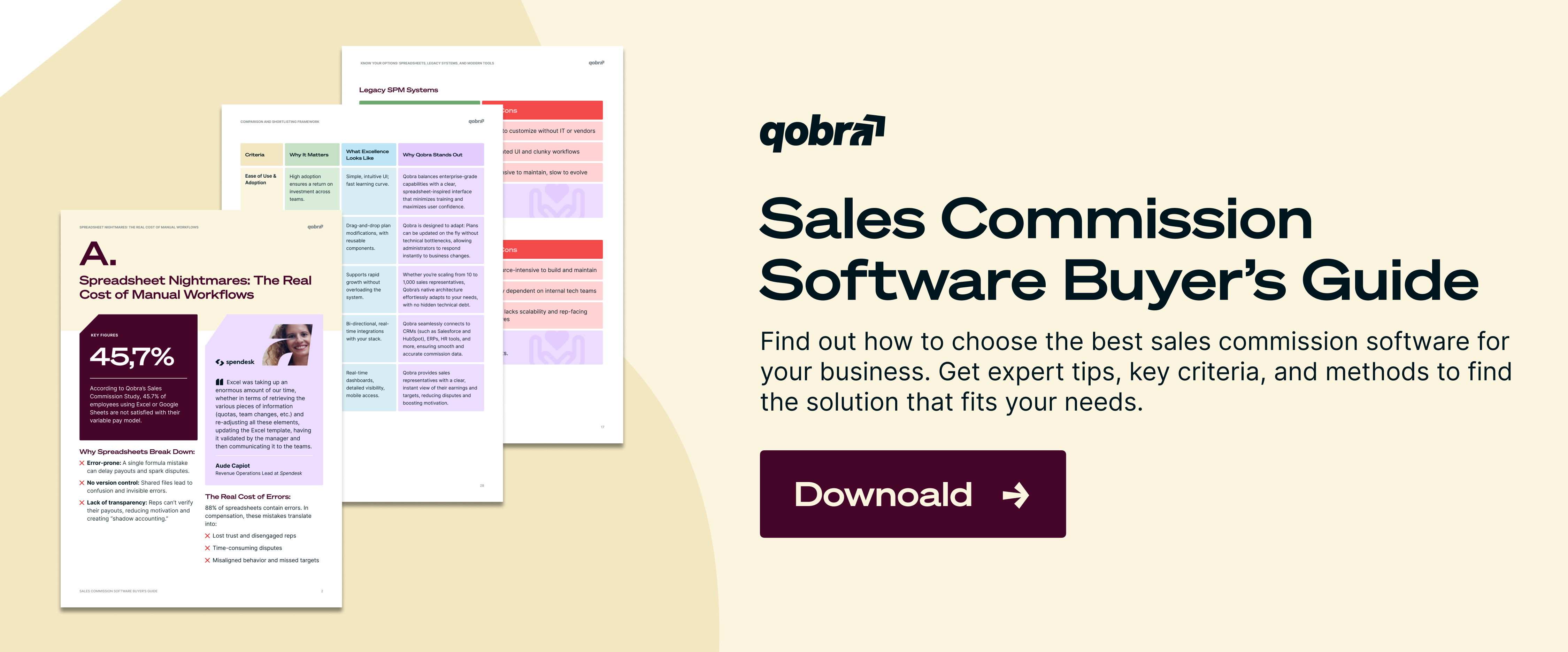
The market for incentive compensation tools is crowded, but a few key players stand out for their ability to serve the needs of modern SaaS companies. When choosing the right commission software, it's crucial to align a vendor's strengths with your company's stage and complexity.
Why each platform fits its "Best for" row: Qobra fits mid-market SaaS teams because it syncs natively with Salesforce, HubSpot, Microsoft Dynamics, Zoho, Pipedrive and Odoo and with Snowflake and BigQuery, handles clawbacks, splits, tiers and accelerators in a no-code plan editor, and goes live in weeks for a US mid-market team (qobra.co, Sept 2026). Visdum fits recurring-revenue plans because the vendor positions it for SaaS companies compensating on ARR, MRR and NRR, with ASC 606 amortization in its reporting (vendor website, Sept 2026). CaptivateIQ fits complex, frequently changing plans because its SmartGrid modeling engine covers tiers, accelerators, splits, clawbacks and draws with version control and audit trails (vendor website, Sept 2026). Everstage fits teams scaling toward enterprise because it names ADP Workforce, Gusto, BambooHR, Workday, HiBob and Ceridian Dayforce for payroll and HRIS and cites a 2.5-month average go-live (vendor website, Sept 2026). Spiff fits Salesforce-centric teams because it is sold as a Sales Cloud add-on at $75 per user per month billed annually, and other systems need paid connectors at $250 per month each (salesforce.com, Sept 2026). Xactly Incent fits large enterprises because it tracks ASC 606 / IFRS 15 capitalization and amortization and connects to Workday, NetSuite, ServiceNow, Snowflake, Salesforce, HubSpot and Microsoft Dynamics, with implementations that usually take several months with a system integrator (vendor website, Sept 2026).
8 commission platforms for SaaS teams compared (2026)
The table below adds the criteria a SaaS buyer needs and that the table above does not cover: the SaaS metrics each vendor names, CRM and billing integrations, US payroll paths, USD pricing and go-live times. Sources: vendor websites and qobra.co, September 2026.
Qobra: Headquartered in New York and Paris, we designed our platform specifically for the needs of fast-growing B2B tech companies. Our philosophy is built around three pillars: speed, transparency, and autonomy. With a dedicated customer success team, we ensure clients are fully onboarded in weeks for a US mid-market team (qobra.co, Sept 2026). Our no-code engine empowers RevOps and Finance teams to manage any plan without technical help, while our real-time rep portal drives motivation and cuts disputes, translating into a 95%+ adoption rate. We've also built AI into the core experience: natural-language plan and view creation, an "Explain my comp" assistant for reps, reporting insights you can query in plain language, and AI agents that simulate future earnings.
Qobra is a sales compensation platform headquartered in New York and Paris, with $1B+ in commissions managed across 300+ companies (qobra.co). It connects natively to Salesforce, HubSpot, Microsoft Dynamics, Zoho, Pipedrive and Odoo, to the Snowflake and BigQuery warehouses, and to Workday, BambooHR and HiBob; ADP, Rippling, Gusto and Paylocity are reached via connector or payroll export. The full list is on the Qobra integrations page.
Reps get real-time dashboards, deal-level statements and deal-close email notifications; Finance gets an audit log of every plan and payout change (user, timestamp, before/after), plan versions with effective dates, reason codes on manual adjustments and multi-step approvals before payroll. Three AI agents build plans in natural language, analyze the data and answer reps' questions as the "Sales Coach", and the Qobra MCP Server exposes them to your own stack (Qobra AI agents). G2 rates Qobra 4.8/5 (1,071 reviews, g2.com, Sept 2026). Pricing is quote-based, by payees and plan complexity.
See the Qobra sales compensation platform page for the full feature list. To test your own SaaS plan rules on the product, book a demo.
Visdum: Visdum is sales compensation software built specifically for SaaS and recurring-revenue businesses, mid-market and up, where commissions follow MRR, expansion, downgrades, and churn rather than one-time deals. Finance teams handle ASC 606 amortization, multi-currency payouts, and audit-ready reporting natively. RevOps ships plan changes, splits, clawbacks, and overrides without engineering tickets. Reps see exactly how every commission was earned, in real time. For SaaS teams past the spreadsheet stage with 50 or more sellers, Visdum treats compensation as infrastructure, not just a calculator.
CaptivateIQ: CaptivateIQ is known for its powerful and flexible calculation engine, which allows users to build intricate commission logic using an interface that feels familiar to advanced spreadsheet users. It excels at handling complex data transformations and is a strong choice for companies with unique, non-standard commission structures that other platforms may struggle to accommodate without workarounds.
Spiff: While most platforms handle all forms of variable pay, Spiff places a special emphasis on gamification and short-term incentives—the "SPIFFs" for which it's named. Its interface is designed to be highly engaging for reps, with real-time leaderboards and contest tracking. It's an excellent choice for sales leaders who want to use compensation to drive specific, short-term behaviors and foster a competitive team culture.
Everstage: Everstage offers a comprehensive suite of features aimed at both mid-market and enterprise clients. They stand out with a user-friendly, no-code plan builder and features like their "Crystal" forecasting module. Their focus on providing a consistent user experience for both administrators and sales reps makes them a solid contender for teams looking to scale their compensation processes.
The Implementation Journey: What to Expect
Migrating from spreadsheets to a dedicated commission platform is a structured project, not just a software purchase. A typical implementation follows a clear path, and understanding it helps set realistic expectations.
A streamlined process for a mid-market company can be completed in as little as two weeks, Visdum 0.65 months on average, Everstage 2.5 months on average, Performio 4 to 8 weeks, Qobra weeks for a US mid-market team (vendor websites, Sept 2026). However, for large enterprises with highly complex global plans, the timeline for a full rollout can extend to several months (Xactly Incent: usually several months with a system integrator; Varicent: enterprise cycles measured in months; vendor websites, Sept 2026). When evaluating vendors, ask for a detailed and realistic timeline for implementing a new sales commission plan.
Moving away from spreadsheets is a critical step in scaling a modern SaaS sales organization. By automating calculations, you not only eliminate errors and save time but also transform compensation into a clear, motivating, and strategic tool. The right platform provides the transparency reps crave, the control finance needs, and the data-driven insights leaders require to drive predictable revenue growth.
Answers to the questions SaaS teams ask
Which commission automation software is best for mid-market SaaS companies?
It depends on the stack and the plan complexity. Qobra fits mid-market SaaS teams because it syncs natively with Salesforce, HubSpot, Microsoft Dynamics, Zoho, Pipedrive and Odoo, handles clawbacks and splits in a no-code editor, and goes live in weeks (qobra.co, Sept 2026). Visdum fits teams paying on ARR, MRR and NRR. QuotaPath fits HubSpot teams that want public pricing from $35 per user per month (vendor websites, Sept 2026).
What is the best sales commission tracking software for a growing SaaS sales team?
A growing team needs reps to see their earnings without asking Finance. Qobra gives reps real-time dashboards, deal-level statements and deal-close email notifications (qobra.co, Sept 2026). CaptivateIQ, Everstage and Performio ship iOS and Android apps, and QuotaPath shows earnings pages inside HubSpot (vendor websites, Sept 2026). Our guide to the best sales commission tracking software compares ten tools on these criteria.
Which platforms fit SaaS teams compensating on ARR, MRR and NRR?
Visdum is the vendor in this comparison whose positioning names ARR, MRR and NRR crediting (vendor website, Sept 2026). Qobra, CaptivateIQ, Everstage, Xactly Incent and Performio handle tiers, accelerators, splits and clawbacks in their calculation engines, the mechanical basis of an ARR or MRR plan; QuotaPath lists splits and clawbacks as limited (vendor websites, Sept 2026). The comparison table above lists the details.
How do you structure a SaaS sales compensation plan?
Start from on-target earnings and the split between base and variable, set the quota on new ARR (or MRR for monthly plans), define the earning event, add accelerators above quota and a clawback window for churn, and decide how AEs and CSMs share expansion credit. Model the plan on last year's deals before rollout with sales compensation modeling software. The Qobra commission calculator simulates tiers, accelerators and cliffs.
What is a typical SaaS commission rate?
There is no single rate. The commission rate follows from on-target earnings, the base-to-variable split and the quota: OTE minus base salary, divided by quota, gives the effective rate on new ARR. Deal size, sales cycle length, gross margin and whether CSMs share expansion credit move it up or down.
Is there a SaaS sales compensation plan template?
Qobra publishes a free commission calculator that simulates tiered, accelerator and cliff plans on your own deal data. A usable template has six parts: role and OTE, quota and measurement period, crediting rules on ARR or MRR, rates and accelerators, clawback terms, and payment timing. In California, the signed written plan is required by Labor Code 2751.
FAQ
How does this software handle SaaS metrics like MRR, upgrades, and churn?
Top-tier sales commission platforms designed for SaaS have calculation engines built to handle these metrics natively. They can automatically ingest data from your CRM or billing system, differentiate between new business MRR and expansion MRR, calculate commissions on the net change for upgrades, and trigger clawback rules when a customer churns. This is fundamental to accurately calculating commission rates effectively in a recurring revenue model.
How quickly can we expect to see a return on investment (ROI)?
Most companies see a full return on their investment within 6 to 12 months. The ROI is driven by several factors: a significant reduction in overpayments (often 3-5% of total commissions), a 60-80% decrease in administrative time spent on calculations, and improved sales performance due to increased motivation and transparency. Exploring the time-saving benefits of an automated tool can help you build a business case.
What integrations are essential for a SaaS company?
At a minimum, you need a deep, native, and bi-directional integration with your CRM (e.g., Salesforce, HubSpot). This is non-negotiable. Beyond that, valuable integrations for SaaS include your billing platform (e.g., Stripe, Chargebee, Zuora) to pull accurate recurring revenue data, your HRIS (e.g., Workday, BambooHR, HiBob) for payee information, and your ERP for financial reconciliation and reporting.
How does your platform ensure data security?
Data security is paramount. Leading platforms are built with enterprise-grade security protocols, including SOC 2 Type II and ISO 27001 certifications. They also ensure compliance with data privacy regulations like GDPR. All data should be encrypted both in transit and at rest, and the platform should offer role-based access controls to ensure users only see the information relevant to them.
Does the software calculate commissions or does it also handle payroll?
This is a critical distinction. Sales commission software specializes in the complex task of calculating the exact variable compensation owed to each employee. It is not a payroll execution system. Once calculations are finalized and approved within the platform, the final payout amounts are exported to your dedicated payroll software (e.g., ADP, Rippling, Gusto, Paylocity or Workday), which then handles the actual bank transfers and manages tax withholdings and deductions, ultimately producing a clear commission statement template for employees.
How does commission software handle clawbacks when a SaaS customer churns?
The plan defines a clawback window and whether the reversal is full or prorated. When the churn or downgrade event arrives from the CRM or billing system, the platform posts a negative adjustment on the rep's next statement with a reason code, logs it in the audit trail and routes it through approval before payroll. Qobra, CaptivateIQ, Everstage, Xactly Incent and Performio list clawbacks in their engines (vendor websites, Sept 2026).
Does commission software integrate with Stripe, Chargebee or Maxio?
Two vendors in this comparison name billing platforms: QuotaPath lists Maxio and Chargebee alongside QuickBooks, Xero, Sage Intacct and NetSuite, and CaptivateIQ lists Stripe and Zuora alongside NetSuite, Sage Intacct, QuickBooks Online and Xero (vendor websites, Sept 2026). Qobra also loads billing data through Snowflake, BigQuery, CSV or SFTP (qobra.co).
How are SaaS commissions treated under ASC 340-40?
Under ASC 340-40, sales commissions are costs to obtain a contract: they are capitalized and amortized rather than expensed in full when paid (FASB codification, asc.fasb.org). Commission software supports this with amortization schedules and journal exports: Xactly Incent tracks capitalization and amortization, Everstage builds amortization schedules, Visdum reports ASC 606 amortization, and Qobra exports an ASC 606 schedule (vendor websites, Sept 2026). Our guide to ASC 606 and sales commissions details the entries.
How long does it take to go live?
Published go-live times differ by vendor: Spiff by Salesforce claims setup in days, Visdum cites a 0.65-month average, CaptivateIQ says weeks instead of months, Qobra states weeks for a US mid-market team, Performio 4 to 8 weeks, QuotaPath 45 to 60 days on Growth, Everstage a 2.5-month average, and Xactly Incent usually takes several months with a system integrator (vendor websites, Sept 2026). Clean CRM data shortens every one of these.
How much does commission software cost for a SaaS company?
Two platforms publish USD prices. QuotaPath charges $35 per user per month plus a $525 monthly platform fee on Growth, or $50 plus $800 on Premium, billed annually with the first five users included. Spiff by Salesforce costs $75 per user per month billed annually, plus $250 per month per additional external connector. Visdum states a first-year investment in the low five figures; Qobra, CaptivateIQ, Everstage, Xactly Incent and Performio are quote-based (vendor websites, Sept 2026).
Related guides